Function Architecture Optimization and Co-Design of Embedded Systems
Bassam Tabbara,Abdallah Tabbara,Alberto Sangiovanni-Vincentelli (auth.)
2000
View book
Book guide and evaluation
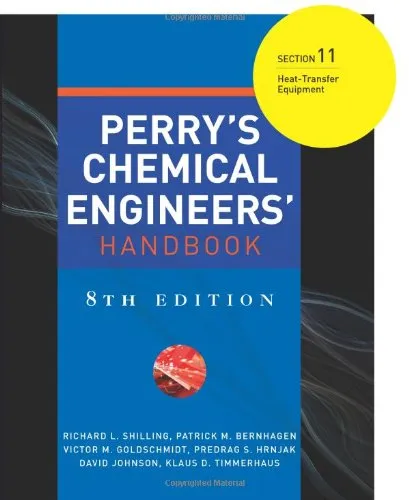
Patrick M. Bernhagen,Victor M. Goldschmidt,Predrag S. Hrnjak,David Johnson,Klaus D. Timmerhaus Richard L. Shilling
0 reviews
Published
pages
views
Introduction to Perry's Chemical Engineers' Handbook, Section 11 Perry's Chemical Engineers' Handbook continues to be a timely resource for educators, students, and professionals in the world of chemical engineering. Section 11, titled "Reactivity and Chemical Facilities,"
Before you read
Perry's Chemical Engineers' Handbook continues to be a timely resource for educators, students, and professionals in the world of chemical engineering. Section 11, titled "Reactivity and Chemical Facilities," offers comprehensive insight into the design, operation, and optimization of chemical processes. This section is geared towards those who seek a deeper understanding of chemical facility design and safety considerations, ensuring both efficiency and compliance with industry standards.
Section 11 of the Handbook is devoted to the various facets of chemical reactivity and the practical aspects of running safe and efficient facilities. It covers a broad spectrum of topics ranging from basic principles of chemical reactions to more sophisticated concepts like process safety management and regulatory compliance. The section begins with an overview of the fundamental chemistry and kinetics that dictate reactions. It progresses to the principles guiding the design of reactors and chemical plants.
Emphasis is also placed on the computational models employed to predict reactor performance and optimize processes. The Handbook delves into modern techniques for monitoring and controlling chemical reactions, incorporating advancements in technology and instrumentation. The comprehensive analysis provided equips readers to address the complexities of fluid dynamics, heat transfer, and mass transfer. This section is an indispensable tool for those looking to innovate within chemical engineering while maintaining high safety standards.
"In the world of chemical engineering, safety is not an option but a foundational pillar that supports innovation."
"Understanding the nuanced dance of molecules is the key to mastering reactivity and achieving efficiency in our processes."
Perry's Chemical Engineers' Handbook, particularly Section 11, matters because it provides an exhaustive resource for the current and next generation of chemical engineers. The synthesis of theory, practical guidance, and safety protocols make it an essential tool for tackling contemporary challenges in the industry. As chemical processes become more complex and safety standards more stringent, understanding the intricate details provided in this handbook is of paramount importance.
The book bridges the gap between classroom education and industrial application, ensuring that engineers are prepared to innovate while adhering to best practices and regulatory requirements. Its detailed approach ensures that concepts are not only learned but mastered, enabling professionals to drive progress in sustainable and safe chemical processing.
Your question is answered in the context of this title and author. Each answer uses 2 points.
0 reviews, 4.5 average out of 5
Sign in to publish a review.
Ask a focused question and learn from the community.
Related references that continue this learning path.
Bassam Tabbara,Abdallah Tabbara,Alberto Sangiovanni-Vincentelli (auth.)