

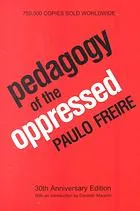
Book guide and evaluation
Pedagogy of the oppressed
Freire, Paulo;Freire, Paulo
English
Advanced
Personal Development
4.5 / 5
0 reviews
2000
Published
186
pages
393
views
Pedagogy of the oppressed critical pedagogy, social justice education Pedagogy of the oppressed explores liberation through education, empowering learners to challenge inequality. Analytical Summary Pedagogy of the oppressed, written by Brazilian educator Paulo Freire, stan
Before you read
What will you get from this book?
Analytical Summary
Pedagogy of the oppressed, written by Brazilian educator Paulo Freire, stands as one of the foundational texts in the field of critical pedagogy. First published in 1968 in Portuguese and later translated into English, it offers a transformative framework for understanding the role of education in the liberation of marginalized populations.
This seminal work is rooted in Freire’s conviction that education must be co-created by teachers and students, fostering dialogue rather than imposing a one-directional transfer of knowledge. Freire critiques what he calls the “banking model” of education, where learners are treated as passive repositories, and instead advocates for a problem-posing model that cultivates critical consciousness — conscientização — among both educators and participants.
Central to the book’s analytical narrative is an acute observation of the structures that perpetuate oppression. Freire illuminates the complex social, economic, and political dynamics in which education operates, arguing that without active participation and reflection, learning becomes an instrument of social control rather than freedom. By situating oppression as both a personal and collective experience, the text challenges readers to engage in praxis — the process of reflection and action upon the world to transform it.
Key Takeaways
The work delivers layered insights that continue to resonate across disciplines concerned with human rights, pedagogy, and social transformation.
Freire's distinction between the banking model and the problem-posing model offers a valuable lens for evaluating educational methodologies in contemporary settings.
Empowerment and liberation are presented not as abstract ideals but as achievable outcomes when learners and educators engage in equitable, dialogic relationships.
Critical pedagogy, as articulated in Pedagogy of the oppressed, calls for recognizing students as co-creators of knowledge, thereby decentralizing authority in educational spaces.
The emphasis on praxis underscores the necessity of linking theory with tangible action for genuine social transformation.
Memorable Quotes
Education either functions as an instrument which is used to facilitate integration of the younger generation into the logic of the present system, and bring about conformity, or it becomes the practice of freedom.Paulo Freire
The oppressed must be their own example in the struggle for their redemption.Paulo Freire
Dialogue cannot exist without humility.Paulo Freire
Why This Book Matters
Pedagogy of the oppressed remains a cornerstone in educational and social justice discourse because it directly addresses the mechanisms of structural inequality and offers practical strategies for resistance.
For academics, educators, and activists, the book serves not only as a theoretical manual but as a moral compass guiding the design and implementation of liberatory educational practices. Its relevance spans contexts — from formal institutions to grassroots movements — underscoring education's potential as a vehicle for both empowerment and social change.
The secondary themes of critical pedagogy and social justice education reinforce the necessity of engaging learners in participatory dialogue, bridging the gap between knowledge acquisition and collective action. Despite the decades since its publication, its call for reflection and praxis has lost none of its urgency.
Inspiring Conclusion
Pedagogy of the oppressed invites us to reimagine education as a shared journey toward liberation, built upon mutual respect, dialogue, and courage.
By engaging critically with its ideas, readers can uncover pathways toward dismantling oppressive systems and nurturing educational environments that honor the voices and experiences of all participants. This authoritative text remains a vital resource for those committed to weaving freedom and justice into the fabric of learning spaces.
Whether you are a scholar, practitioner, or simply a curious reader, the next step is to immerse yourself in the book, reflect deeply on its messages, and share them with communities ready to act. Pedagogy of the oppressed challenges and equips us to envision — and enact — education aligned with human dignity.
Ask this book
Your question is answered in the context of this title and author. Each answer uses 2 points.
Sign in to ask the book assistant.
Reader reviews
0 reviews, 4.5 average out of 5
No reviews yet
If you have read this book, help the next reader with your experience.
Write a review
Sign in to publish a review.
Reader questions and answers
Ask a focused question and learn from the community.
Sign in to ask or answer a question.
No questions yet
Be the first to ask a clear, useful question.
What to read next
Related references that continue this learning path.
Invent and Wander: The Collected Writings of Jeff Bezos, With an Introduction by Walter Isaacson
Walter Isaacson;Jeff Bezos
2020
View book
The Book of Joy: Lasting Happiness in a Changing World
Dalai Lama,Desmond Tutu,Douglas Carlton Abrams
2016
View book
The daily stoic : 366 meditations on wisdom, perseverance, and the art of living
Hanselman, Stephen;Holiday, Ryan
2016
View book