

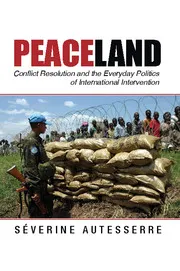
Book guide and evaluation
Peaceland: Conflict Resolution and the Everyday Politics of International Intervention
Séverine Autesserre
English
Intermediate
Personal Development
4.2 / 5
0 reviews
2014
Published
343
pages
448
views
Peaceland: Conflict Resolution and the Everyday Politics of International Intervention Peacebuilding practices, International conflict mediation Peaceland: Conflict Resolution and the Everyday Politics of International Intervention explores everyday realities shaping pe
Before you read
What will you get from this book?
Analytical Summary
Peaceland: Conflict Resolution and the Everyday Politics of International Intervention offers an unconventional and deeply researched look into the daily lives, habits, and perspectives of international peacebuilders. Rather than focusing solely on policy frameworks or high-level negotiations, this authoritative work examines the micro-level practices that, often unintentionally, hinder or help effective peacebuilding in conflict zones.
Drawing from extensive ethnographic fieldwork, personal observations, and professional engagement, the author examines how cultural, organizational, and interpersonal dynamics influence the broader objectives of international intervention. The analysis illuminates how decisions made in routine operations ripple outward, shaping both local communities and global strategies.
Combining vivid narratives and academic rigor, the book moves beyond abstract theory to reveal the human dimension behind peacebuilding: the relationships, traditions, and everyday choices that contribute to success or failure. This perspective challenges common assumptions and invites policymakers, scholars, and practitioners to rethink their approaches.
Key Takeaways
The book’s core insights transform how we perceive international interventions, shining light on subtle yet powerful influences in conflict resolution.
First, the daily routines of expatriate peacebuilders matter greatly. Habits such as socializing primarily within expatriate circles can unintentionally create distance from local communities, thereby limiting cultural understanding and trust. Second, institutional structures often reward short-term outputs over long-term relationship building, undermining sustained peace. Third, genuine collaboration requires challenging entrenched bureaucratic norms and actively engaging in adaptive, locally sensitive strategies.
Fourth, the work underscores the importance of humility and reflexivity among international actors. Recognizing one’s own biases and limitations is critical for impactful conflict resolution. Finally, effective peacebuilding is less about a prescriptive set of policies and more about cultivating a responsive, context-aware approach, informed by the lived realities of “Peaceland.”
Memorable Quotes
“True change begins with the smallest interactions in the field.”Unknown
“Peacebuilding is not only about treaties and councils—it is about shared coffee and lived trust.”Unknown
“Structures shape choices, and choices shape peace.”Unknown
Why This Book Matters
Peaceland: Conflict Resolution and the Everyday Politics of International Intervention matters because it brings a nuanced, ground-level lens to discussions often dominated by political elites and formal agreements.
For academics, the book offers a rich empirical foundation for rethinking intervention strategies through the lens of anthropology, political science, and sociology. Practitioners gain actionable insights into the practical barriers and enablers of success in conflict zones, while policymakers are urged to integrate human-centered approaches into policy formation.
Its relevance extends beyond traditional peacebuilding; it informs broader debates on international aid, humanitarian logistics, and the ethics of intervention. By focusing on lived experience rather than abstract ideals, the book has become a touchpoint for those committed to meaningful, respectful, and sustainable collaboration in complex environments.
Inspiring Conclusion
In closing, Peaceland: Conflict Resolution and the Everyday Politics of International Intervention invites readers to step into the lived realities behind the headlines of conflict and peace.
Whether you are an academic, a field practitioner, or a policymaker, this work encourages you to critically assess the everyday decisions, relationships, and interactions that shape intervention outcomes. It underscores the transformative power of small, intentional acts and the importance of embedding cultural sensitivity and humility in every aspect of peacebuilding.
Your next step could be to read the book in depth, share its insights with colleagues, or spark discussion in your organization. By doing so, you contribute to a global dialogue that redefines success in conflict resolution—not only at summits but also in the daily practices of “Peaceland.”
Ask this book
Your question is answered in the context of this title and author. Each answer uses 2 points.
Sign in to ask the book assistant.
Reader reviews
0 reviews, 4.2 average out of 5
No reviews yet
If you have read this book, help the next reader with your experience.
Write a review
Sign in to publish a review.
Reader questions and answers
Ask a focused question and learn from the community.
Sign in to ask or answer a question.
No questions yet
Be the first to ask a clear, useful question.
What to read next
Related references that continue this learning path.


The Art of Laziness: Overcome Procrastination & Improve Your Productivity
Library Mindset
2023
View book