Book guide and evaluation
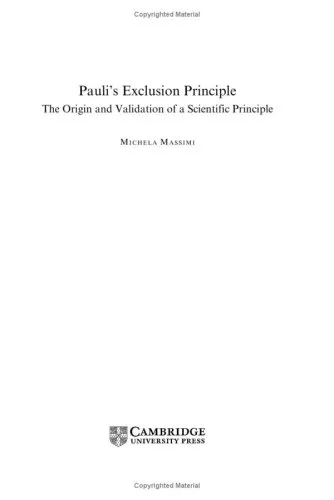
Pauli's exclusion principle: the origin and validation of a scientific principle
Michela Massimi
English
Intermediate
novel
4.3 / 5
0 reviews
2005
Published
227
pages
661
views
Welcome to the intricate world of quantum mechanics and the fascinating history behind one of its foundational principles: Pauli's exclusion principle. My book, "Pauli's Exclusion Principle: The Origin and Validation of a Scientific Principle," delves deep into the historical a
Before you read
What will you get from this book?
Welcome to the intricate world of quantum mechanics and the fascinating history behind one of its foundational principles: Pauli's exclusion principle. My book, "Pauli's Exclusion Principle: The Origin and Validation of a Scientific Principle," delves deep into the historical and philosophical underpinnings of this crucial scientific tenet. This introduction aims to guide you through a detailed exploration of its significant contributions to science and its broader implications for our understanding of the natural world.
Detailed Summary of the Book
The book offers a comprehensive examination of the genesis and validation of Pauli's exclusion principle, a cornerstone of quantum mechanics formulated by Wolfgang Pauli in 1925. The principle posits that no two fermions (such as electrons) can occupy the same quantum state within a quantum system simultaneously. This seemingly straightforward idea has profound implications for the structure of atoms, the behavior of matter, and, ultimately, the very fabric of the universe.
Throughout the chapters, I trace the development of this principle from its origins in Pauli's early work, through its reception in the scientific community, to its present-day significance in both theoretical and applied physics. The narrative is enriched by contextualizing these scientific developments within the broader landscape of philosophical inquiry and historical events.
Key Takeaways
- Understanding the context in which Pauli developed his exclusion principle and how it challenged existing paradigms in atomic theory.
- The role of creativity, intuition, and rigorous empiricism in the formulation and acceptance of new scientific ideas.
- An exploration of the principle's profound implications for quantum mechanics and how it laid the groundwork for further discoveries in particle physics and chemistry.
- The interdisciplinary dialogue between physics and philosophy that enriched the evolution of modern science.
Famous Quotes from the Book
"The exclusion principle stands as a memorial to the power of theoretical innovation in transforming our understanding of the unseen quantum world."
"As much a philosophical conundrum as a scientific assertion, Pauli's principle remains a testament to the interplay of imagination and logic in the pursuit of knowledge."
Why This Book Matters
In an era where scientific advancements come at an unprecedented pace, understanding the historical and philosophical foundations of key scientific principles is more critical than ever. This book not only sheds light on Pauli's exclusion principle from a multifaceted perspective but also highlights the interdisciplinary nature of scientific inquiry. For students, scholars, and science enthusiasts alike, this exploration offers insights into how scientific principles are formulated, debated, and ultimately accepted as part of our accumulated knowledge.
By emphasizing the narrative of scientific discovery, the book also serves as an inspiration for future generations of scientists, encouraging them to embrace a holistic approach that values creativity alongside empirical rigor.
Join me in this scholarly journey to uncover the story behind one of the most significant scientific principles that continue to shape our understanding of the universe.
Ask this book
Your question is answered in the context of this title and author. Each answer uses 2 points.
Sign in to ask the book assistant.
Reader reviews
0 reviews, 4.3 average out of 5
No reviews yet
If you have read this book, help the next reader with your experience.
Write a review
Sign in to publish a review.
Reader questions and answers
Ask a focused question and learn from the community.
Sign in to ask or answer a question.
No questions yet
Be the first to ask a clear, useful question.
What to read next
Related references that continue this learning path.