
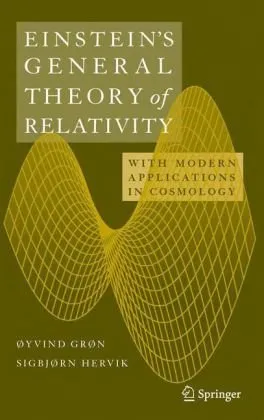
Einstein's general theory of relativity: with modern applications in cosmology
Øyvind Grøn,Sigbjorn Hervik
2007
View book
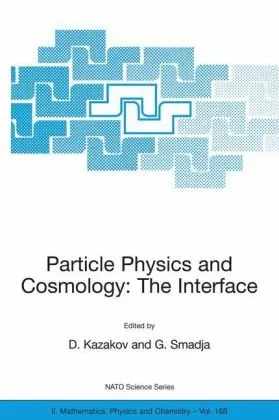
Book guide and evaluation
Dimitri I. Kazakov,G. Smadja
0 reviews
Published
pages
views
Introduction to "Particle Physics and Cosmology: The Interface" Welcome to the intriguing journey presented in "Particle Physics and Cosmology: The Interface", a scholarly exploration of two of science's most fascinating fields. This book serves as a unifying bridge betwee
Before you read
Welcome to the intriguing journey presented in "Particle Physics and Cosmology: The Interface", a scholarly exploration of two of science's most fascinating fields. This book serves as a unifying bridge between the microscopic world of particle physics and the grand expanse of cosmology, providing readers with a comprehensive understanding of how these two disciplines intertwine. Authored by Dimitri I. Kazakov and G. Smadja, this text lays a strong foundation for anyone interested in the symbiotic relationship between the subatomic and cosmic realms. In this introduction, we summarize the book, highlight its key takeaways, and explain why it is an essential resource for students, professionals, and enthusiasts alike.
"Particle Physics and Cosmology: The Interface" delves deep into the dynamic interplay between elementary particles—the fundamental building blocks of matter—and the larger universe, bound together by the laws of physics. The authors explore profound concepts such as the Higgs boson, the Big Bang, dark matter, and quantum field theory. Spanning numerous topics, the book explains how the discoveries in particle accelerators relate to the cosmos' broader mysteries. You will find discussions about the Standard Model of particle physics and its relationship to early-universe cosmology, the origins of cosmic inflation, and even the enigmatic phenomena of dark matter and dark energy.
This work balances theoretical rigor with accessibility, introducing cutting-edge concepts in a manner comprehensible to readers from diverse scientific backgrounds. With meticulous detail, the authors bridge the gap between highly technical research and the questions facing modern cosmology in a way that feels engaging and thought-provoking. Whether analyzing cosmic microwave background radiation or delving into quantum mechanics, each chapter builds on the premise that the smallest particles in the universe can explain its largest-scale structures.
"The smallest components of matter are not separate from the universe itself—they are the storytellers of its origins and destiny."
"In understanding the interface between the quantum and the cosmological, we uncover not only the mechanics but the poetry of existence."
This book stands at the crossroads of two monumental scientific disciplines—particle physics and cosmology. Its significance lies in the way it unravels both the microcosm and the macrocosm, demonstrating that the two are inherently connected. It empowers readers to think beyond the boundaries of separate fields, encouraging an interdisciplinary perspective that is critical for advancing modern science.
Aspiring physicists, researchers, and science enthusiasts will find the book invaluable, not only for its vast content but also for the clarity and coherence it provides on complex topics. With its blend of pedagogy and cutting-edge research, it serves as both a reference and an inspirational read. By sparking curiosity about fundamental questions—what are we made of, and where did we come from?—the book invites readers to participate in the grand adventure of scientific discovery.
The authors' ability to condense decades of research into an engaging and articulate narrative makes this text an enduring work. It challenges us to see how the universe's grand design is shaped by interactions that occur in the tiniest fractions of space and time. Indeed, this book underscores the enduring need for collaboration between theoretical and experimental physics.
Your question is answered in the context of this title and author. Each answer uses 2 points.
0 reviews, 4.5 average out of 5
Sign in to publish a review.
Ask a focused question and learn from the community.
Related references that continue this learning path.
Øyvind Grøn,Sigbjorn Hervik
Jeffrey O. Bennett,Megan Donahue,Nicholas O Schneider,Mark Voit
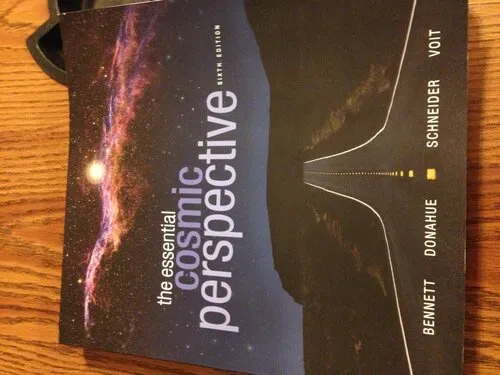
Jeffrey O. Bennett,Megan O. Donahue,Nicholas Schneider,Mark Voit