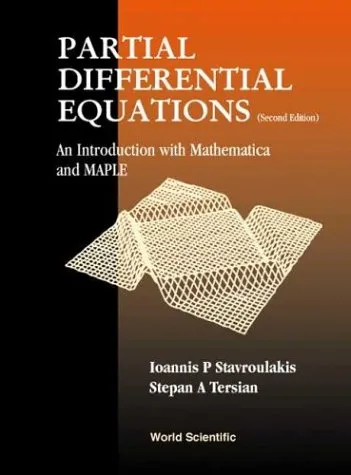
Book guide and evaluation
Partial Differential Equations: An Introduction with Mathematica and Maple
Ioannis P. Stavroulakis,Stepan A. Tersian
English
Beginner
Mathematics
4.5 / 5
0 reviews
2004
Published
319
pages
582
views
Introduction to "Partial Differential Equations: An Introduction with Mathematica and Maple" Welcome to the world of advanced mathematics! "Partial Differential Equations: An Introduction with Mathematica and Maple" by Ioannis P. Stavroulakis and Stepan A. Tersian serves as a
Before you read
What will you get from this book?
Introduction to "Partial Differential Equations: An Introduction with Mathematica and Maple"
Welcome to the world of advanced mathematics! "Partial Differential Equations: An Introduction with Mathematica and Maple" by Ioannis P. Stavroulakis and Stepan A. Tersian serves as a comprehensive and practical resource for anyone delving into the intricate realm of partial differential equations (PDEs). This book seamlessly blends theoretical insights with modern computational tools, equipping both professionals and students with a valuable reference in their journey of understanding PDEs.
Detailed Summary of the Book
Partial differential equations form the backbone of numerous scientific disciplines, including physics, engineering, biology, and finance. This book offers a methodical introduction to the theory and numerical solutions of PDEs, making it an accessible guide for beginners while remaining rich enough for advanced readers. With its balanced approach to theory and application, the text provides readers with the mathematical rigor behind PDEs while introducing computational methods using powerful tools like Mathematica and Maple.
Starting with the fundamental concepts of PDEs, the book explains first-order equations, methods of characteristics, and classification of second-order PDEs. Gradually, it delves into advanced topics such as boundary value problems, Fourier series, eigenvalue problems, and Green's functions. Each theoretical concept is accompanied by step-by-step examples and practical applications, ensuring that readers can relate abstract mathematics to real-world scenarios.
What sets this book apart is its integration of computational software. With the advent of computer-assisted mathematics, the inclusion of Mathematica and Maple provides readers with a hands-on learning experience. By showcasing how these tools can be used to solve and visualize complex PDE problems, this book bridges the gap between classical analysis and modern computational methods.
Key Takeaways
- A comprehensive introduction to the theory and numerical solutions of PDEs.
- Clear explanations of first-order and second-order partial differential equations.
- Step-by-step guidance on solving boundary value problems using Fourier series and Green’s functions.
- Integration of Mathematica and Maple for computational solutions and visualizations.
- A perfect balance between theoretical foundations and practical applications.
Famous Quotes from the Book
“Partial differential equations are not merely mathematical abstractions but powerful tools to model and solve significant real-world problems.”
“The integration of computational tools like Mathematica and Maple exemplifies the evolving landscape of mathematics in the 21st century.”
Why This Book Matters
This book is more than just a textbook—it is a gateway to understanding one of the most vital areas of modern applied mathematics. For students, it offers a structured and approachable way to grasp the richness of PDE theory. For professionals, it serves as a practical guide with advanced methods and computational tools to address real-world challenges.
Today’s technological advancements demand a deeper integration of mathematics with computational resources. By introducing Mathematica and Maple, the book not only brings theoretical knowledge to life but also empowers readers to explore, experiment, and innovate in their respective fields. It extends beyond academia, influencing industries such as engineering, data science, healthcare, and more.
The strategic blend of traditional mathematics and advanced software makes this book a timeless reference for anyone interested in mastering partial differential equations. Its relevance grows as we advance further into a data-driven, computational era where practical, efficient, and accurate solutions are more critical than ever before.
Ask this book
Your question is answered in the context of this title and author. Each answer uses 2 points.
Sign in to ask the book assistant.
Reader reviews
0 reviews, 4.5 average out of 5
No reviews yet
If you have read this book, help the next reader with your experience.
Write a review
Sign in to publish a review.
Reader questions and answers
Ask a focused question and learn from the community.
Sign in to ask or answer a question.
No questions yet
Be the first to ask a clear, useful question.
What to read next
Related references that continue this learning path.