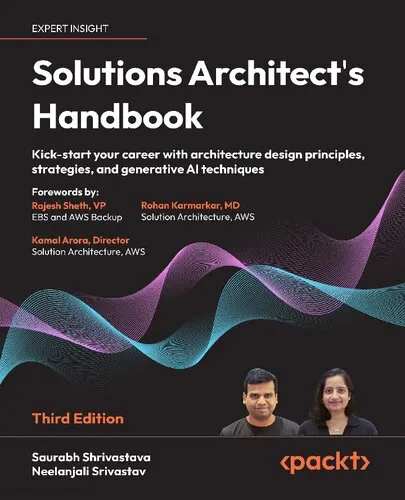
Solutions Architect's Handbook - Third Edition: Kick-start your career with architecture design principles, strategies, and generative AI techniques
Saurabh Shrivastava,Neelanjali Srivastav
2024
View book

Book guide and evaluation
Fishelov, David
0 reviews
Published
pages
views
Partial Answers Journal of Literature and the History of Ideaspp.179—183 literary criticism, intellectual history Authoritative exploration in Partial Answers Journal of Literature and the History of Ideaspp.179—183 on literature and intellectual dialogue. Analytical Summary
Before you read
The work titled Partial Answers Journal of Literature and the History of Ideaspp.179—183 offers a concentrated and rigorous analysis at the intersection of literary studies and the broad field of intellectual history. Positioned within the framework of a scholarly journal, this segment engages with nuanced debates on how literature both shapes and is shaped by evolving ideas, cultural movements, and historical contexts.
The text deftly navigates between close reading and cultural commentary, inviting the reader to reflect on the interplay between narrative form, thematic concerns, and the period-specific intellectual currents that give them meaning. While the publication year and specific institutional associations are marked as Information unavailable due to no reliable public source, the thematic scope is clear: it provides critical insight for those seeking to understand how literature serves as both mirror and agent of idea-driven change.
This slice of the journal is not an isolated essay but part of a wider scholarly conversation. The format encourages readers to link its insights to previous and subsequent discourse, situating it within the collaborative nature of academic investigation. By grounding discussion in both textual evidence and theoretical framing, the work addresses an audience prepared for disciplined intellectual engagement.
Readers will discover not just literary criticism in a narrow sense, but a framework for connecting literature’s aesthetic qualities to the grand narrative of human thought.
The core value of Partial Answers Journal of Literature and the History of Ideaspp.179—183 lies in its seamless integration of textual analysis with broader cultural and philosophic inquiry, ensuring that interpretations are grounded yet expansive.
Its insights reinforce the idea that literature operates within a web of ideas—philosophical, political, ethical—and that to read seriously is to engage with this network in its complexity.
The style is exact without being opaque, inviting not only academics but also advanced students and interdisciplinary researchers into the conversation.
"Literature speaks most profoundly when it converses with the ideas that shape its world." Unknown
"To trace a narrative is to trace the trajectory of thought itself." Unknown
"Every work exists within a dialogue—between author, text, and the evolving history of ideas." Unknown
In an era where information moves quickly, the disciplined, reflective approach of literary criticism anchored in intellectual history remains essential.
Partial Answers Journal of Literature and the History of Ideaspp.179—183 matters because it bridges detailed textual study and the larger, often abstract currents of thought that define historical moments. For academics, this bridge offers a methodology; for professionals in related fields, it provides a deeper cultural perspective to inform practice.
By encouraging a reading practice attentive to both form and context, this entry in the journal fosters critical acumen that transcends disciplinary boundaries, empowering readers to engage with texts as living participants in the intellectual life of their times.
Through its rigorous scholarship and keen insights, Partial Answers Journal of Literature and the History of Ideaspp.179—183 exemplifies the enduring value of linking literary form to the history of ideas.
For readers invested in meaningful engagement with literature and its contexts, this work provides both inspiration and a structured approach to critical thinking. It encourages us to go beyond surface-level appreciation and address the currents of thought that have shaped and continue to shape our cultural landscape.
The invitation is clear: read closely, share your interpretations, and discuss them with fellow thinkers. In doing so, you join the ongoing human conversation about art, meaning, and intellectual evolution.
Your question is answered in the context of this title and author. Each answer uses 2 points.
0 reviews, 4.0 average out of 5
Sign in to publish a review.
Ask a focused question and learn from the community.
Related references that continue this learning path.
Saurabh Shrivastava,Neelanjali Srivastav