
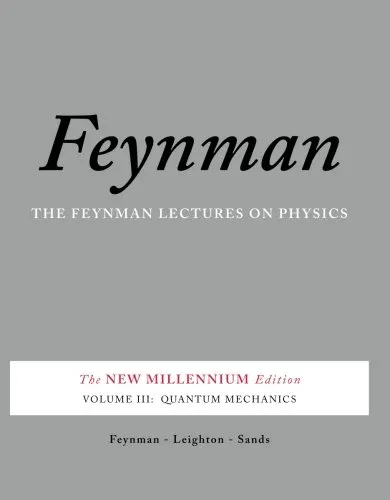
The Feynman Lectures on Physics, Vol. III: The New Millennium Edition: Quantum Mechanics
Richard P. Feynman,Robert B. Leighton,Matthew Sands
2011
View book
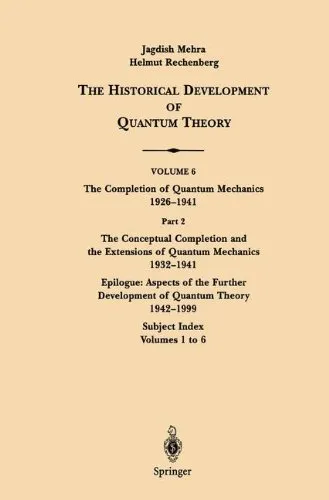
Book guide and evaluation
Jagdish Mehra,H. Rechenberg
0 reviews
Published
pages
views
Welcome to our exploration of a pivotal era in the evolution of quantum mechanics, where foundational concepts were meticulously completed and extended. "The Conceptual Completion and Extensions of Quantum Mechanics 1932-1941" with an epilogue discussing the subsequent developm
Before you read
Welcome to our exploration of a pivotal era in the evolution of quantum mechanics, where foundational concepts were meticulously completed and extended. "The Conceptual Completion and Extensions of Quantum Mechanics 1932-1941" with an epilogue discussing the subsequent developments from 1942 to 1999, is an authoritative text that captures the essence of a transformative period in modern physics. Authored by Jagdish Mehra and H. Rechenberg, this book provides an in-depth analysis of both historical progressions and conceptual breakthroughs that shaped the landscape of quantum theory.
The book is a meticulous synthesis of the developments within quantum mechanics from the years 1932 to 1941—a period marked by the culmination of ideas seeded in the earlier years of the 20th century. This volume documents how physicists like Paul Dirac, Werner Heisenberg, and Erwin Schrödinger, among others, contributed to the refinement of quantum mechanics into a more structured science.
The authors offer a detailed exploration of how quantum mechanics was not only about theoretical frameworks but also about experimental verifications that provided robustness to the theory. The book covers complex topics such as quantum field theory, the uncertainty principle, and the matrix mechanics that emerged during this period.
Following the initial period, the book transitions to an epilogue that examines how these developments laid the groundwork for further advancements post-1941, delving into areas like quantum electrodynamics, quantum chromodynamics, and the eventual formulation of the Standard Model of particle physics.
“The evolution of quantum mechanics is a testament to the ingenuity of human thought, navigating through the limitations of classical intuition to uncover a realm bound by probabilities and operators.”
“The story of quantum mechanics is not just the story of isolated discoveries but a tapestry of interconnected innovations that continue to inspire.”
This book stands as an essential read for anyone interested in the historical and conceptual foundations of modern physics. It provides a comprehensive perspective on how early quantum mechanics evolved through rigorous scientific inquiry and debate. The authors' detailed narrative offers readers not only an understanding of the fundamental shifts in physics during the early 20th century but also an appreciation for the meticulous nature of scientific advancement.
Moreover, the book underscores the importance of both collaboration and intellectual tension in the scientific community, highlighting how these elements can drive revolutionary advancements. Its epilogue extends the understanding of quantum mechanics by elucidating its trajectory and impact on subsequent scientific developments up to the end of the 20th century.
Your question is answered in the context of this title and author. Each answer uses 2 points.
0 reviews, 4.5 average out of 5
Sign in to publish a review.
Ask a focused question and learn from the community.
Related references that continue this learning path.
Richard P. Feynman,Robert B. Leighton,Matthew Sands
Jean-Louis Basdevant,Jean Dalibard