Electromagnetic Fields and Waves: Microwave and mmWave Engineering with Generalized Macroscopic Electrodynamics
Eugene I. Nefyodov,Sergey M. Smolskiy
2019
View book
Book guide and evaluation
Y. Zhang,T. K. Sarkar
0 reviews
Published
pages
views
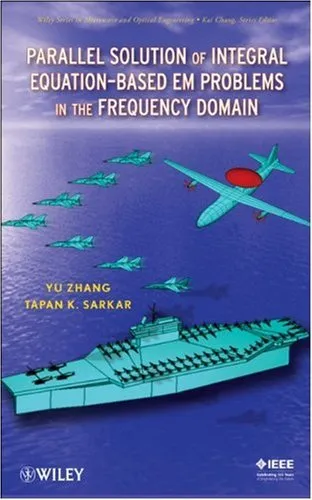
Introduction to "Parallel Solution of Integral Equation-Based EM Problems in the Frequency Domain" The field of computational electromagnetics (CEM) continues to evolve as increasingly complex systems require advanced methods to model and solve electromagnetics (EM) proble
Before you read
The field of computational electromagnetics (CEM) continues to evolve as increasingly complex systems require advanced methods to model and solve electromagnetics (EM) problems. Parallel Solution of Integral Equation-Based EM Problems in the Frequency Domain is a comprehensive guide that addresses the challenges and opportunities in solving integral equation-based EM problems in the frequency domain using parallel computing techniques. Authored by experts in the field, this book offers cutting-edge insights into the practical implementation of parallel computing methods and how they can be applied to the electromagnetic domain for scientific, industrial, and research purposes.
Designed as part of the esteemed "Wiley Series in Microwave and Optical Engineering," this book bridges traditional theoretical electromagnetics and modern computational innovations. It combines mathematical rigor with detailed practical examples to provide a balanced and in-depth exploration of integral equation methods, a class of techniques that are critical for modeling wave interactions, antenna design, and scattering phenomena. Additionally, the book focuses on how parallel computing—notably high-performance computing—can overcome the computational challenges posed by large-scale problems in electromagnetics.
The book begins by introducing the readers to the fundamental concepts of integral equation formulations for electromagnetic analysis. The authors build a strong foundation by explaining the mathematical principles behind these formulations and their application to real-world issues such as scattering and radiation problems. Subsequently, the transition toward advanced numerical methods enables a practical approach to approximate solutions, specifically focusing on the moment method (MoM).
As the book progresses, emphasis is placed on the challenges of solving larger systems derived from integral equations. Here, the authors present parallel computing methods as an effective solution to combat constraints like memory and computation time. Various parallelization strategies, both for shared-memory and distributed-memory architectures, are discussed in depth. Techniques such as domain decomposition, parallel factorization, and preconditioning are explained with mathematical rigor and supported by implementation frameworks.
The authors also delve into the implementation of parallel algorithms on modern architectures, including multi-core CPUs and advanced GPU platforms, with key insights into managing scalability, load balancing, and communication overhead. Finally, the book concludes with applied case studies that showcase real-world examples of the effectiveness of parallel computing in solving problems related to EM wave scattering, antenna arrays, and other complex structures.
"The quest for solving complex electromagnetic problems is not limited by human intellect but by the computational capabilities we can harness."
"Parallel computing is not merely the future of computational electromagnetics; it is the present we must embrace to solve the challenges of tomorrow."
This book addresses the ever-relevant topic of computational scalability, a key requirement in the modern era of engineering design and simulation. As electromagnetic modeling grows more sophisticated, the need for efficient computational solutions becomes paramount. Integral equation techniques are versatile, yet they encounter significant barriers when applied to large-scale problems. This is where the detailed strategies described in this text become invaluable, offering solutions that are not merely theoretical but implementable.
Furthermore, the book is a vital resource for engineers, researchers, and students alike. It provides the foundational knowledge needed to understand integral equations while offering advanced computational techniques applicable in industry, research, and academia. By focusing on parallel solutions, this book contributes meaningfully to high-performance computing literature and enhances the capability to address a variety of disciplines such as antenna engineering, biomedical applications, and wireless communications.
By the end of this book, readers will have learned not only how to solve EM problems effectively but also how to innovate in this growing field, leveraging state-of-the-art computational techniques to push the boundaries of what is possible.
Your question is answered in the context of this title and author. Each answer uses 2 points.
0 reviews, 4.0 average out of 5
Sign in to publish a review.
Ask a focused question and learn from the community.
Related references that continue this learning path.
Eugene I. Nefyodov,Sergey M. Smolskiy