

Book guide and evaluation
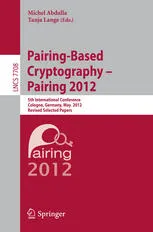
Pairing-Based Cryptography – Pairing 2012: 5th International Conference, Cologne, Germany, May 16-18, 2012, Revised Selected Papers
Xusheng Zhang,Kunpeng Wang,Dongdai Lin (auth.),Michel Abdalla,Tanja Lange (eds.)
English
Beginner
Art
4.4 / 5
0 reviews
2013
Published
347
pages
171
views
Introduction The field of cryptography has witnessed rapid advancements over the last few decades, with pairing-based cryptography emerging as one of the most significant developments. The book "Pairing-Based Cryptography – Pairing 2012: 5th International Conference, Cologne,
Before you read
What will you get from this book?
Introduction
The field of cryptography has witnessed rapid advancements over the last few decades, with pairing-based cryptography emerging as one of the most significant developments. The book "Pairing-Based Cryptography – Pairing 2012: 5th International Conference, Cologne, Germany, May 16-18, 2012, Revised Selected Papers" encapsulates cutting-edge research and discussions from this pivotal event. This volume presents a carefully curated collection of revised papers that showcase groundbreaking work made possible by pairing-based cryptography (PBC). It serves as a foundational resource for researchers, scholars, and practitioners delving into cryptographic methods and their real-world applications.
Here, readers are introduced to a comprehensive spectrum of topics ranging from theoretical underpinnings to applied methodologies facilitated by bilinear pairings in cryptographic systems. With contributions from leading experts, this book is a testament to the evolving nature of secure communication and computational techniques.
Detailed Summary of the Book
"Pairing-Based Cryptography – Pairing 2012" is not merely a collection of academic papers; it is a deep dive into the pivotal techniques, applications, and challenges associated with PBC. The book builds on the foundation of the 5th International Conference on Pairing-Based Cryptography, which brought together researchers and practitioners at the forefront of advancing cryptographic solutions.
The conference presented a large variety of topics focused on pairing-based encryption, signature schemes, and identity-based encryption (IBE). In this book, these topics are analyzed in detail, encompassing both theoretical insights and practical applications. The contents include research on advanced pairing computation, optimized cryptographic protocols, and analyses of attack resistance in various scenarios.
Additionally, the volume dives into novel techniques such as zero-knowledge proofs built upon pairings, efficient constructions for multi-party computation, and developments in homomorphic encryption and secure cloud services. Researchers delve into lattice-based methods and quantum-resistant cryptography to ensure the longevity of pairing-based approaches against future adversarial technologies.
Throughout the chapters, the emphasis remains on balancing elegance in mathematical proofs, efficiency in computation, and robustness in cryptographic security to address real-world use cases. This book is essential for understanding the state-of-the-art in PBC research, both from a theoretical perspective and a practical viewpoint.
Key Takeaways
- An in-depth exploration of pairing-based cryptographic systems, from foundational principles to applications.
- Detailed discussions on secure and efficient implementations of bilinear pairings.
- New insights into identity-based encryption, signature schemes, and advanced cryptographic protocols.
- Analysis of attack vectors and how pairing-based methods enhance security.
- Contributions from leading cryptography researchers worldwide, offering diverse perspectives on PBC.
Famous Quotes from the Book
The book contains numerous quotes and statements reflective of the innovative mindset shaping pairing-based cryptography. Here are a few standout excerpts:
"Pairing-based cryptography bridges gaps between theory and practice, offering a versatile toolkit for secure communication in the digital age."
"Efficient computation of pairings on elliptic curves lies at the heart of both speed and security in modern cryptographic systems."
"The true challenge lies not just in creating secure systems but in anticipating future adversaries through quantum-resistant design."
Why This Book Matters
In an age where the importance of secure communication cannot be overstated, "Pairing-Based Cryptography – Pairing 2012" emerges as a key text for several reasons:
First, it addresses critical technological advancements in cryptography that harness bilinear pairings in their design. Pairing-based methods have unlocked capabilities—such as identity-based encryption and aggregate signatures—that were previously unattainable with traditional cryptographic approaches. By offering a thorough examination of these concepts, the book equips readers with knowledge to understand and leverage these techniques.
Second, this book serves as a repository of insights from the world’s foremost experts. The depth of expertise captured through the conference contributions ensures that readers are exposed to the best practices and groundbreaking ideas shaping modern cryptography. It also includes practical components, ensuring readers are prepared to implement these techniques into real-world systems.
Finally, the book emphasizes not just the present but the future of cryptography. By discussing quantum resistance, multi-party computation, and efficiency optimization, it anticipates the evolving threats and technological landscapes of tomorrow. For researchers, developers, and encryption practitioners, this forward-looking approach makes the book invaluable in planning long-term cryptographic solutions.
In conclusion, "Pairing-Based Cryptography – Pairing 2012" serves as a cornerstone text for understanding, innovating, and applying cryptographic tools rooted in pairing-based principles. Its importance lies in its ability to not just inform, but inspire future advancements in secure computation.
Ask this book
Your question is answered in the context of this title and author. Each answer uses 2 points.
Sign in to ask the book assistant.
Reader reviews
0 reviews, 4.4 average out of 5
No reviews yet
If you have read this book, help the next reader with your experience.
Write a review
Sign in to publish a review.
Reader questions and answers
Ask a focused question and learn from the community.
Sign in to ask or answer a question.
No questions yet
Be the first to ask a clear, useful question.
What to read next
Related references that continue this learning path.

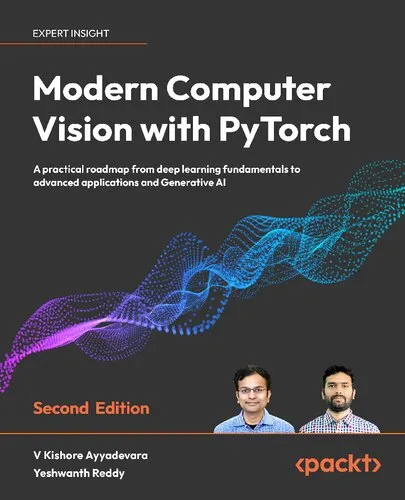
Modern Computer Vision with PyTorch: A Practical Roadmap From Deep Learning Fundamentals to Advanced Applications and Generative AI, 2nd Edition
V Kishore Ayyadevara,Yeshwanth Reddy
2023
View book