
Book guide and evaluation
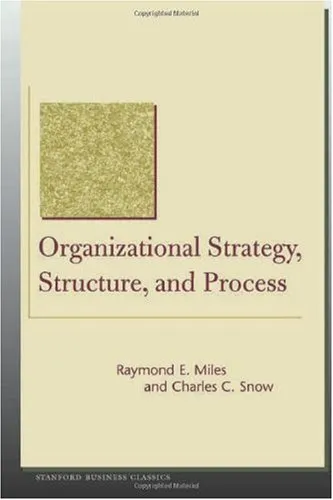
Organizational Strategy, Structure, and Process (Stanford Business Classics)
Raymond Miles,Charles Snow
English
Beginner
Economics
4.5 / 5
0 reviews
2003
Published
304
pages
368
views
Introduction to "Organizational Strategy, Structure, and Process" A pioneering work in the realm of organizational theory, "Organizational Strategy, Structure, and Process" provides profound insights into how businesses navigate their strategic landscapes. Authored by Raym
Before you read
What will you get from this book?
Introduction to "Organizational Strategy, Structure, and Process"
A pioneering work in the realm of organizational theory, "Organizational Strategy, Structure, and Process" provides profound insights into how businesses navigate their strategic landscapes. Authored by Raymond Miles and Charles Snow, this seminal text paints a comprehensive picture of the interplay between strategy formulation, structural adaptation, and organizational processes that lead to sustainable success.
Detailed Summary of the Book
The book systematically explores how organizations develop and execute strategies through the lens of the 'adaptive cycle.' This cycle emphasizes three essential components: entrepreneurial problem-solving, engineering production systems, and administrative decision-making. Miles and Snow introduce four archetypes or strategy typologies - Defenders, Prospectors, Analyzers, and Reactors - each representing distinct strategic approaches and orientations that organizations employ to align themselves with environmental demands.
Defenders focus on efficiency and stability, maintaining secure positions within their respective markets. Conversely, Prospectors thrive on innovation and are continually seeking new opportunities. Analyzers blend the traits of Defenders and Prospectors, balancing exploration and exploitation to mitigate risk. Reactors are characterized by a lack of consistent strategy, often responding hastily to external changes without a coherent plan.
Through a richly detailed exploration, the book underscores the importance of aligning organizational structure and process with the chosen strategic orientation. By doing so, it provides readers with a robust framework to identify and overcome alignment challenges, ensuring both competitiveness and adaptability in rapidly changing environments.
Key Takeaways
- Understand the different strategic typologies: Defenders, Prospectors, Analyzers, and Reactors.
- Recognize the importance of the adaptive cycle in organizational strategy.
- Learn how structural alignment with strategies can improve organizational performance.
- Gain insights into resolving misalignments between strategy, structure, and process.
Famous Quotes from the Book
"An organization is a complex social system that must transform human as well as nonhuman resources into useful goods and services."
"Successfully aligning strategy, structure, and processes will provide a durable competitive advantage."
Why This Book Matters
This book is a cornerstone in organizational theory and strategic management literature. By delineating clear strategic orientations and emphasizing the importance of alignment, Miles and Snow offer a timeless framework that remains relevant in both academic and practical domains. Organizations continually face the dual challenges of innovation and stability, and this text provides the tools and insights necessary to address these dynamics effectively. Its lasting impact is evident in the way it equips leaders and managers to navigate complexity and drive their organizations towards enduring success.
Ask this book
Your question is answered in the context of this title and author. Each answer uses 2 points.
Sign in to ask the book assistant.
Reader reviews
0 reviews, 4.5 average out of 5
No reviews yet
If you have read this book, help the next reader with your experience.
Write a review
Sign in to publish a review.
Reader questions and answers
Ask a focused question and learn from the community.
Sign in to ask or answer a question.
No questions yet
Be the first to ask a clear, useful question.
What to read next
Related references that continue this learning path.
Applied Data Science: Lessons Learned for the Data-Driven Business
Martin Braschler,Thilo Stadelmann,Kurt Stockinger
2019
View book
Sustainable Innovation and Entrepreneurship
Rolf Wustenhagen,Jost Hamschmidt,Sanjay Sharma,Mark Starik
2008
View book
Innovating organization and management : new sources of competitive advantage
Nicolai J Foss; et al
2012
View book