

Strategic Management: A Competitive Advantage Approach, Concepts
David, Fred R;David, Forest R
2016;2017
View book
Book guide and evaluation
Elisabeth Julie Vargo
0 reviews
Published
pages
views
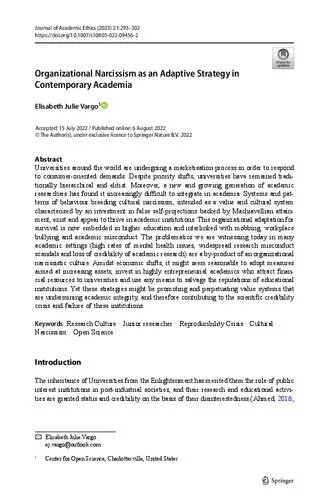
Introduction to 'Organizational Narcissism as an Adaptive Strategy in Contemporary Academia' Welcome to the exploration of a critical yet often overlooked phenomenon in academic institutions: organizational narcissism. In a rapidly changing educational landscape, understan
Before you read
Welcome to the exploration of a critical yet often overlooked phenomenon in academic institutions: organizational narcissism. In a rapidly changing educational landscape, understanding how narcissistic tendencies can be cultivated as adaptive strategies is essential. This book delves into the complex interplay between organizational behaviors and the evolving demands of academia.
'Organizational Narcissism as an Adaptive Strategy in Contemporary Academia' investigates the rise of narcissistic traits within academic institutions. It explores how universities and colleges, as organizations, have developed narcissistic characteristics in response to external pressures such as marketization, competition, and global rankings. The book blends research-based insights with real-world examples to illustrate the impact of these behaviors on institutional culture, faculty dynamics, and student experiences.
The narrative unfolds in a structured manner, beginning with defining organizational narcissism and tracing its origins in psychological theory. It then moves on to analyze the manifestations of narcissism in academic settings, such as the pursuit of prestige, excessive self-promotion, and the prioritization of brand over substance. The later chapters critique the implications of these behaviors, questioning the sustainability and ethical implications of using narcissism as an adaptive strategy.
"In the race for prestige and recognition, institutions may mirror the very narcissism they seek to study, creating a paradox that reshapes the soul of academia."
"While narcissism often carries negative connotations, its strategic application within academic organizations reveals a nuanced landscape of survival and adaptation."
As academia continues to navigate the challenges of globalization, technological advancement, and shifting societal expectations, understanding organizational narcissism becomes crucial. This book sheds light on the dichotomy within academic institutions that strive for both introspective integrity and external validation. It serves as an important resource for educators, administrators, and policymakers interested in fostering balanced and ethically sound institutional environments.
By unraveling the dynamics of narcissism as an adaptive strategy, this book invites readers to critically engage with their own institutions, prompting an evaluation of the values and strategies that define contemporary higher education.
Your question is answered in the context of this title and author. Each answer uses 2 points.
0 reviews, 4.5 average out of 5
Sign in to publish a review.
Ask a focused question and learn from the community.
Related references that continue this learning path.
David, Fred R;David, Forest R

Daniel F. Oriesek,Jan Oliver Schwarz


Nezameddin Faghih (editor),Amir Forouharfar (editor)