
Book guide and evaluation
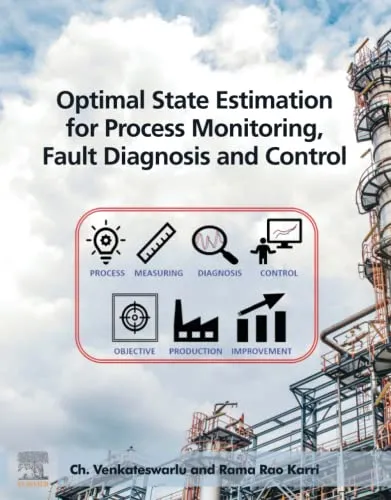
Optimal State Estimation for Process Monitoring, Fault Diagnosis and Control
Ch. Venkateswarlu M.Tech PhD,Rama Karri
English
Beginner
Engineering
4.9 / 5
0 reviews
2022
Published
376
pages
183
views
Introduction to "Optimal State Estimation for Process Monitoring, Fault Diagnosis and Control" "Optimal State Estimation for Process Monitoring, Fault Diagnosis and Control" is a foundational guide for engineers, researchers, and practitioners working in the areas of process
Before you read
What will you get from this book?
Introduction to "Optimal State Estimation for Process Monitoring, Fault Diagnosis and Control"
"Optimal State Estimation for Process Monitoring, Fault Diagnosis and Control" is a foundational guide for engineers, researchers, and practitioners working in the areas of process systems engineering. This book delivers a comprehensive understanding of state estimation techniques, providing a seamless bridge between theoretical concepts and practical applications in process monitoring, fault diagnosis, and control systems.
Written with clarity and precision, the book addresses the intricacies of state estimation while presenting actionable solutions to real-world operational challenges. Engineers and scientists interested in advanced topics, such as Kalman Filters, nonlinear estimation methods, and their application to fault-tolerant systems, will find this book a valuable resource. The book integrates fundamental concepts, mathematical derivations, and practical domain-specific examples to support robust process management and decision-making strategies.
Detailed Summary of the Book
At its core, this book serves as an essential resource for mastering the art and science of state estimation in dynamic systems under uncertainty. It covers the following key aspects:
- The basics of state estimation and its significance in dynamic systems.
- Detailed treatment of the Kalman Filter and its variants, such as Extended Kalman Filter (EKF) and Unscented Kalman Filter (UKF).
- Advanced state estimation methods, including Moving Horizon Estimation and Particle Filters.
- Application of state estimation in process monitoring, control systems, and fault diagnosis.
- Case studies and practical insights into resolving complex engineering challenges.
The book progresses from foundational principles to more sophisticated methods, ensuring that readers develop a firm theoretical base before diving into intricate concepts. Each chapter is supplemented with examples, illustrations, and exercises to enhance understanding and reinforce learning. Furthermore, the discussion on fault diagnosis highlights the importance of detecting, isolating, and mitigating failures to enable continuous and reliable system performance.
Key Takeaways
Readers of this book will gain the following valuable insights:
- The ability to design and implement state estimators to model complex industrial processes.
- A deep understanding of various filter designs and their strengths and limitations in different scenarios.
- Techniques to enhance system reliability through effective fault diagnosis and control strategies.
- Practical guidance for applying theoretical estimations in operational environments and industries.
- How to develop robust and adaptive process management systems in uncertain and dynamic conditions.
By mastering these takeaways, readers can significantly enhance their proficiency in ensuring optimal, fault-tolerant, and efficient control systems in industrial operations.
Famous Quotes from the Book
The book features several motivational and insightful statements that highlight its core messages. Here are a few notable quotes:
“State estimation is the cornerstone of modern control strategies; it offers a lens to observe, predict, and optimize dynamic systems.”
“Fault diagnosis is not just about identifying failures; it is about preserving the integrity and safety of the entire process.”
“Optimal state estimation is the balance between theoretical precision and practical implementation in uncertain environments.”
Why This Book Matters
In today’s fast-paced industrial environments, the ability to monitor, predict, and control processes effectively is critical. "Optimal State Estimation for Process Monitoring, Fault Diagnosis and Control" fills a vital gap by providing a technically rigorous yet practical framework for engineers and researchers. Here’s why this book matters:
- It addresses real-world challenges in designing and optimizing complex systems.
- It empowers professionals to understand the root causes of system failures and implement corrective measures with confidence.
- The book bridges the gap between academia and industry, offering theoretical insights and practical solutions in equal measure.
- It emphasizes creating fault-tolerant systems, essential for ensuring safety and reliability in critical operations.
- With its focus on adaptive filtering and modern estimation techniques, this book enables readers to stay ahead in the field of process systems engineering.
In summary, this book is not just an academic textbook; it is a roadmap for solving some of the most pressing problems in process monitoring, control, and fault diagnosis with confidence and precision. For anyone interested in elevating their understanding and career in this field, this book is an indispensable resource.
Ask this book
Your question is answered in the context of this title and author. Each answer uses 2 points.
Sign in to ask the book assistant.
Reader reviews
0 reviews, 4.9 average out of 5
No reviews yet
If you have read this book, help the next reader with your experience.
Write a review
Sign in to publish a review.
Reader questions and answers
Ask a focused question and learn from the community.
Sign in to ask or answer a question.
No questions yet
Be the first to ask a clear, useful question.
What to read next
Related references that continue this learning path.

Modern Computer Vision with PyTorch: A Practical Roadmap From Deep Learning Fundamentals to Advanced Applications and Generative AI, 2nd Edition
V Kishore Ayyadevara,Yeshwanth Reddy
2023
View book