Introduction to "Optimal Control and Dynamic Games: Applications in Finance, Management Science, and Economics"
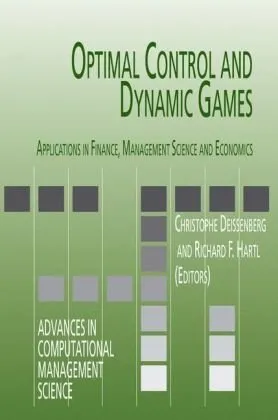
Welcome to the world of decision-making excellence, where science meets strategy. “Optimal Control and Dynamic Games: Applications in Finance, Management Science, and Economics” brings together the powerful methodologies of optimal control and dynamic games, marrying them with practical applications in the fields of finance, management science, and economics. This book is a deep dive into how businesses, policymakers, and researchers can optimize decision-making processes using mathematical models and game-theoretic principles.
Written by Christophe Deissenberg and Richard F. Hartl, this book masterfully combines theoretical rigor with real-life insights, making it an indispensable tool for academics, practitioners, and students aiming to enhance their understanding of optimal strategies in dynamic and competitive environments. Whether your area of interest lies in corporate finance, economic policy-making, or managerial science, this book is your gateway to mastering complex systems, predicting outcomes, and achieving precision in decision-making.
Detailed Summary of the Book
"Optimal Control and Dynamic Games" begins by laying down the foundational frameworks of optimal control theory and dynamic games, exploring their mathematical underpinnings and their role in solving real-world problems. The text is divided into three key thematic areas: finance, management science, and economics. In each of these sections, the authors discuss in detail how the concepts can be applied to analyze and optimize decision-making in both competitive and cooperative settings.
In the finance section, the book explores how portfolio optimization, pricing of financial instruments, and risk management can benefit from these techniques. The management science section delves into applications such as inventory management, supply chain optimization, and resource allocation in organizations. Finally, the economics section covers topics like policy formulation, market dynamics, and growth models, demonstrating how optimal control and game theories can be instrumental in addressing macroeconomic and microeconomic challenges.
The structure of the book ensures a gradual progression from theory to application. Mathematical derivations are introduced with clarity, followed by real-world case studies that solidify the reader's understanding. Whether you are new to these topics or an experienced researcher, the book caters to diverse skill levels, striking a balance between accessibility and intellectual depth.
Key Takeaways
- Gain a comprehensive understanding of optimal control theory and dynamic games, starting from the basics to advanced topics.
- Understand how to formulate and solve problems in finance, management science, and economics using these methodologies.
- Explore real-world examples and applications that integrate theoretical principles with practical contexts.
- Learn advanced techniques for strategic decision-making in competitive and cooperative environments.
- Develop the ability to predict outcomes and design optimization strategies using mathematical modeling and game-theoretic approaches.
Famous Quotes from the Book
“The power of optimal control and game theory lies in their ability to turn complexity into clarity, providing decision-makers with tools that navigate uncertainty and competition.”
“Dynamic games bring forth the essence of strategy – it is not just about winning; it is about understanding the moves of others and responding with precision.”
“In a world where change is the only constant, optimization is not an option; it is a necessity.”
Why This Book Matters
This book is not just a scholarly text; it is a roadmap for addressing some of the most pressing challenges in finance, management, and economics. With industries becoming increasingly competitive and globalized, the ability to make informed, strategic decisions is essential for success. This is where the powerful frameworks of optimal control and dynamic games come into play.
Furthermore, the interdisciplinary nature of the book makes it particularly valuable. Whether it is a financial analyst looking to optimize portfolios, a policymaker aiming to design robust economic policies, or a manager focused on supply chain efficiency, the insights within this book are universally applicable. The authors’ blend of theoretical exploration and practical application ensures that readers are not only equipped with knowledge but also with actionable strategies.
Ultimately, "Optimal Control and Dynamic Games" is not just a book; it is a toolkit for those who want to excel in dynamic and competitive environments. With its thorough analysis, practical relevance, and forward-looking perspective, this book continues to be a cornerstone text for academics, professionals, and decision-makers navigating the evolving complexities of the modern world.