Practical Troubleshooting of Electrical Equipment and Control Circuits
Mark Brown, Jawahar Rawtani M.Sc(Tech) MBA, Dinesh Patil B.E (I&C) DipEE
2005
View book
Book guide and evaluation
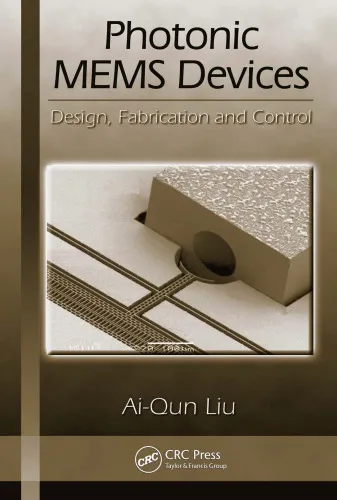
Ai-Qun Liu
0 reviews
Published
pages
views
Detailed Summary of the Book "Optical Science and Engineering" by Ai-Qun Liu presents a comprehensive exploration of the principles, methodologies, and applications in the rapidly evolving field of optical science. Designed for both students and professionals, this
Before you read
"Optical Science and Engineering" by Ai-Qun Liu presents a comprehensive exploration of the principles, methodologies, and applications in the rapidly evolving field of optical science. Designed for both students and professionals, this book integrates fundamental concepts in optics with modern engineering techniques, ensuring readers gain both theoretical depth and practical insights.
The book begins with a solid grounding in classical optics, covering wave theory, geometrical optics, and the behavior of light in various media. This foundation is crucial for understanding more advanced subjects such as photonics, optical signal processing, and laser engineering. The structure of the text is carefully crafted to guide readers from foundational knowledge to specialized applications, making it not only a learning resource but also a practical reference guide.
Emphasizing engineering perspectives, each chapter combines rigorous mathematical formulations with real-world examples. Readers will encounter discussions on lens design, fiber optics, holography, and optical instrumentation, along with the exploration of cutting-edge technologies like optical communication systems and biophotonics. The text bridges academic theory with industrial application, fostering a holistic understanding of both basic research and its translation into technology.
The integration of problem sets, illustrative diagrams, and experimental setups allows for active engagement with the subject matter. By presenting optical science within an engineering framework, Ai-Qun Liu enables readers to appreciate the interdisciplinary nature of the field, where physics, materials science, electronics, and computational modeling converge.
This book equips the reader with not only knowledge but also the intellectual tools necessary to innovate in optical science and engineering.
Ai-Qun Liu distills decades of academic and engineering experience into succinct statements that resonate with readers on intellectual and practical levels.
"Optics is not merely the study of light; it is the language through which we shape, control, and communicate information in the modern world."
"Engineering with light demands precision, creativity, and a profound respect for the laws of physics."
"The bridge between optical science and engineering is built with knowledge, experimentation, and imagination."
In an age where optical technologies underpin everything from global communication networks to medical imaging, "Optical Science and Engineering" serves as a definitive guide for navigating this critical field.
The importance of this book lies in its ability to convey complex optical concepts in a way that is accessible without sacrificing depth. For students, it provides a structured path to mastery, from introductory principles to advanced engineering applications. For professionals, it offers a reliable reference for tackling real-world optical design and implementation challenges.
Reflecting the interdisciplinary evolution of optical engineering, Ai-Qun Liu’s work highlights emerging trends and future possibilities, preparing readers for innovations in photonics, laser advancements, and quantum optics. By bridging theoretical understanding with engineering practice, the book fosters the development of critical thinking and problem-solving skills essential for modern optical engineers.
In industries such as telecommunications, aerospace, defense, and healthcare, the ability to harness and manipulate light determines technological competitiveness. This text ensures that readers are not only conversant with the principles of optical science but are also prepared to apply those principles to develop technologies that can transform how we live and work.
Ultimately, "Optical Science and Engineering" matters because it empowers its audience to see beyond equations and apparatus, revealing the profound impact of optical innovation on society and the economy. It stands as both an academic cornerstone and a professional tool for those committed to shaping the future through light.
Your question is answered in the context of this title and author. Each answer uses 2 points.
0 reviews, 4.5 average out of 5
Sign in to publish a review.
Ask a focused question and learn from the community.
Related references that continue this learning path.
Mark Brown, Jawahar Rawtani M.Sc(Tech) MBA, Dinesh Patil B.E (I&C) DipEE

Volker Weitbrecht