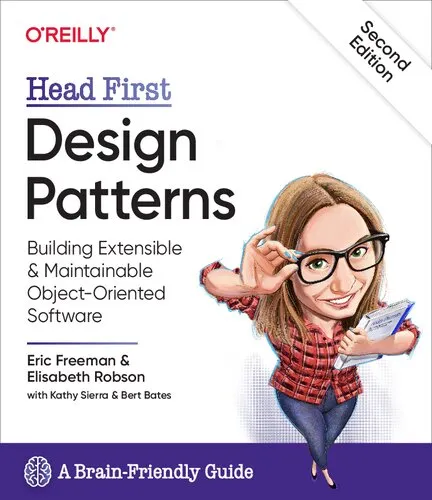
Head First Design Patterns: Building Extensible and Maintainable Object-Oriented Software
Eric Freeman,Elisabeth Robson
2020
View book
Book guide and evaluation
Raymond Tay
0 reviews
Published
pages
views
Introduction OpenCL Parallel Programming Development Cookbook is a comprehensive guide for both budding and experienced developers looking to streamline their computational tasks through OpenCL. With over 50 recipes, the book delves into the intricacies of creating efficie
Before you read
OpenCL Parallel Programming Development Cookbook is a comprehensive guide for both budding and experienced developers looking to streamline their computational tasks through OpenCL. With over 50 recipes, the book delves into the intricacies of creating efficient, high-performance applications that leverage the rich capabilities of OpenCL across heterogeneous platforms. This introduction sets the stage for a deeper understanding of OpenCL, emphasizing both theoretical foundations and practical implementation.
OpenCL Parallel Programming Development Cookbook provides a step-by-step approach to mastering OpenCL for high-performance computing. Beginning with the fundamentals, readers are introduced to the OpenCL architecture and its ecosystem, enabling them to grasp the basics of parallel programming. The book progresses to cover a wide array of topics, including memory management, performance optimization, and integration with other parallel programming models. Each chapter is designed to build upon the previous one, gradually increasing in complexity and depth.
The book is structured to encourage hands-on learning. Each recipe begins with a problem statement, followed by a detailed solution and explanation. Real-world examples are employed to illustrate complex concepts, making it easier for readers to relate and apply what they learn. By the end of the book, developers will be equipped with the knowledge to craft robust and scalable applications that can run efficiently on multiple devices, from GPUs to CPUs and even FPGAs.
"Mastering parallel programming opens the doors to a new realm of computational possibilities, where efficiency meets scalability."
"In the world of OpenCL, innovation and optimization walk hand in hand, empowering developers to surpass conventional processing limitations."
"Each line of OpenCL code can be seen as a conversation with your hardware, commanding it to achieve the extraordinary."
In an era where technology pervades every aspect of our lives, the demand for high-performance computing solutions is at an all-time high. OpenCL, with its platform-independent promise, serves as a powerful tool in the arsenal of modern developers. This book is an invaluable resource that demystifies the complexities of OpenCL, making it accessible to anyone eager to enhance their programming skills. The practical, recipe-based approach ensures that readers are not only absorbing theoretical knowledge but also acquiring the hands-on experience needed to tackle real-world challenges.
OpenCL Parallel Programming Development Cookbook matters because it bridges the gap between theoretical concepts and practical application. As industries increasingly rely on parallel computing to handle large data sets and complex computations, expertise in OpenCL becomes a crucial differentiator. This book equips readers with the skills to critically assess computational problems and deploy effective OpenCL solutions, thereby enabling them to contribute meaningfully to technological advancements in various fields.
Your question is answered in the context of this title and author. Each answer uses 2 points.
0 reviews, 4.3 average out of 5
Sign in to publish a review.
Ask a focused question and learn from the community.
Related references that continue this learning path.
Eric Freeman,Elisabeth Robson
James Reinders,James Jeffers