
Book guide and evaluation
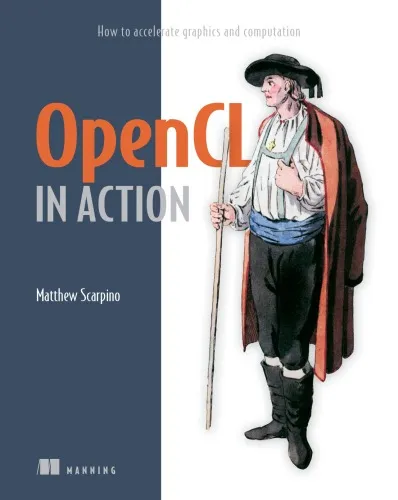
OpenCL in Action: How to Accelerate Graphics and Computations
Matthew Scarpino
English
Beginner
Software Engineering
4.0 / 5
0 reviews
2011
Published
458
pages
435
views
Introduction to "OpenCL in Action: How to Accelerate Graphics and Computations" Today’s modern computing tasks demand exceptional performance, whether it's rendering stunning graphics in video games, processing large datasets for machine learning, or performing high-performanc
Before you read
What will you get from this book?
Introduction to "OpenCL in Action: How to Accelerate Graphics and Computations"
Today’s modern computing tasks demand exceptional performance, whether it's rendering stunning graphics in video games, processing large datasets for machine learning, or performing high-performance simulations. OpenCL (Open Computing Language) offers an open and flexible standard for parallel programming, allowing developers to unlock the power of heterogeneous systems such as CPUs, GPUs, and other processors. In my book, OpenCL in Action: How to Accelerate Graphics and Computations, I delve deeply into the principles, tools, and techniques to harness OpenCL effectively and efficiently.
The book is a practical guide tailored for developers looking to accelerate their applications and computations. It builds a foundation for understanding OpenCL concepts while providing hands-on examples and code snippets that walk readers through real-world use cases. With extensive focus on performance optimization, this book empowers you to take full control of your hardware and achieve results that were once thought unattainable with traditional sequential programming.
A Detailed Summary of the Book
At its core, OpenCL in Action addresses the challenges many developers face when trying to utilize the full computational power of their systems. The book begins by introducing the concept of heterogeneous computing and why OpenCL's open standard is uniquely positioned to support a wide variety of devices.
The journey starts with the basics of OpenCL programming: understanding the platform model, device model, and programming model. Step by step, you'll learn how to write OpenCL kernels, manage memory in high-performance systems, and execute tasks across multiple devices. The book features practical examples ranging from matrix multiplication and image processing to physics simulations and financial modeling. Each example is designed to provide not just a theoretical understanding, but also the technical expertise needed to implement solutions in your own projects.
Later chapters focus on advanced topics such as optimizing memory access patterns, debugging OpenCL applications, and leveraging OpenCL with frameworks like OpenGL and Vulkan. These topics are vital for developers working in graphics or engineers building high-demand scientific computing solutions.
Finally, the book provides insights into the future of heterogeneous programming and how OpenCL is evolving to meet new challenges. It's more than just a technical manual—it's a guide that inspires developers to think differently about how to utilize their computing resources.
Key Takeaways
- Learn the foundations of OpenCL, including its architecture, programming model, and terminology.
- Master the creation and execution of OpenCL kernels for parallel computing tasks.
- Understand how to manage memory efficiently and optimize computational performance in OpenCL.
- Explore real-world examples in graphics, numerical computation, and scientific domains.
- Gain knowledge of advanced debugging and performance tuning techniques for OpenCL applications.
- Integrate OpenCL with complementary frameworks such as OpenGL for graphics and Vulkan for high-performance computing.
- Discover the potential future advancements in heterogeneous computing and parallel processing.
Famous Quotes from the Book
"OpenCL enables developers to think beyond the CPU, unleashing the full computational power of their systems through parallel processing."
"Heterogeneous computing isn't just a buzzword; it's a paradigm shift in how we approach performance optimization."
"When harnessed correctly, OpenCL doesn't just accelerate applications—it transforms them into tools of unprecedented capability."
Why This Book Matters
In an era where performance can make or break software, knowing how to leverage hardware effectively is crucial. OpenCL in Action equips developers with the skills and knowledge necessary to maximize the potential of diverse processing units, including GPUs and CPUs. Its focus on open standards and cross-platform capabilities ensures that the concepts are relevant to a wide audience, from game developers to data scientists and researchers in high-performance computing fields.
Furthermore, OpenCL stands out as an important technology in the industry due to its portability and flexibility. Unlike other vendor-specific solutions, OpenCL offers freedom and compatibility across a wide range of devices. The book helps readers navigate the steep learning curve of OpenCL with clarity and precision, removing barriers and enabling success in performance-critical projects.
Whether you're building cutting-edge graphics software, improving the efficiency of machine learning algorithms, or developing simulations for scientific research, this book provides the foundation you need to excel.
Ask this book
Your question is answered in the context of this title and author. Each answer uses 2 points.
Sign in to ask the book assistant.
Reader reviews
0 reviews, 4.0 average out of 5
No reviews yet
If you have read this book, help the next reader with your experience.
Write a review
Sign in to publish a review.
Reader questions and answers
Ask a focused question and learn from the community.
Sign in to ask or answer a question.
No questions yet
Be the first to ask a clear, useful question.
What to read next
Related references that continue this learning path.
Numerical Solution of Partial Differential Equations on Parallel Computers
Hans Petter Langtangen
2005
View book
Domain Decomposition Methods for the Numerical Solution of Partial Differential Equations
Tarek Poonithara Abraham Mathew (auth.)
2008
View book
Numerical Linear Algebra on High-Performance Computers
Jack J. Dongarra,Iain S. Duff,Danny C. Sorensen,Hank A. van der Vorst
1987
View book