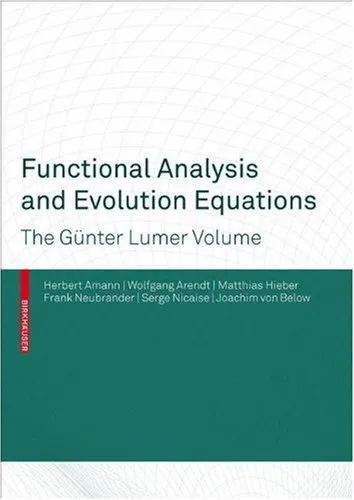
Functional analysis and evolution equations: The Gunter Lumer volume
Herbert Amann,Wolfgang Arendt,Matthias Hieber,Frank Neubrander,Serge Nicaise,Joachim Below
2008
View book

Book guide and evaluation
Nicolaus Copernicus
0 reviews
Published
pages
views
Introduction to 'On the Revolutions of Heavenly Spheres' - Translated by Rosen Written in the early 16th century by Nicolaus Copernicus, 'On the Revolutions of Heavenly Spheres' represents a tremendous shift in understanding the cosmos. This groundbreaking work
Before you read
Written in the early 16th century by Nicolaus Copernicus, 'On the Revolutions of Heavenly Spheres' represents a tremendous shift in understanding the cosmos. This groundbreaking work, meticulously translated by Rosen, offers insights into Copernican heliocentrism, challenging the widely accepted geocentric model of the universe. This introduction delves into the profound ideas presented in the book, their significance, and the enduring legacy of this revolutionary text.
At its core, 'On the Revolutions of Heavenly Spheres' proposes the heliocentric model of the universe. Copernicus postulates that the sun, rather than the Earth, is at the center of the universe. This model posits that all planets, including Earth, revolve around the sun. Copernicus meticulously calculated the positions and paths of the celestial bodies, offering a mathematical foundation for his ideas.
The book is divided into several sections, each elaborating on different aspects of the celestial sphere and the apparent motion of the planets. Copernicus addresses the Ptolemaic system's complexities and inconsistencies, proposing simpler and more harmonious models through mathematical rigor combined with observational astronomy. The treatise begins with theories of the universe's structure, moving through detailed astronomical tables that serve to predict planetary positions accurately.
“Finally we shall place the Sun himself at the center of the Universe.”
“For what could be more beautiful than the heavens which contain all beautiful things.”
This monumental work represents a critical pivot in the history of science. By challenging the geocentric model embraced by the Church and scholars for centuries, 'On the Revolutions of Heavenly Spheres' emboldened future generations of scientists to explore beyond accepted doctrines. It marked the beginning of the Scientific Revolution, influencing the work of luminaries like Johannes Kepler, who refined heliocentric theories, and Galileo Galilei, whose observations supported Copernican ideas.
Copernicus's approach to observation and mathematics set a precedent for empirical investigation, championing the integration of data-driven analysis in scientific inquiry. The book's impact extends beyond astronomy; it represents a broader intellectual awakening, enshrining critical thought and challenging authority as essential tenets of progress. Even today, nearly five centuries later, its principles resonate throughout the scientific community, reminding us to look up and explore the cosmos with curiosity and skepticism.
Your question is answered in the context of this title and author. Each answer uses 2 points.
0 reviews, 4.5 average out of 5
Sign in to publish a review.
Ask a focused question and learn from the community.
Related references that continue this learning path.
Herbert Amann,Wolfgang Arendt,Matthias Hieber,Frank Neubrander,Serge Nicaise,Joachim Below

Lars Hörmander (auth.)