

Book guide and evaluation
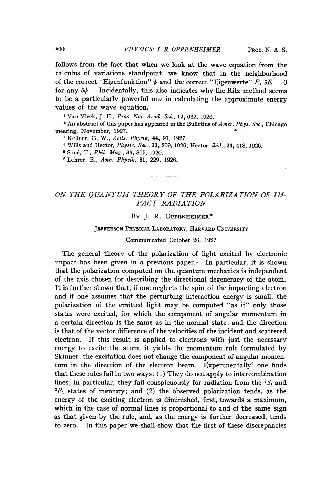
On the Quantum Theory of the Polarization of Impact Radiation
Oppenheimer J. R.
English
Beginner
Quantum Mechanics
4.4 / 5
0 reviews
1927
Published
6
pages
467
views
Introduction to "On the Quantum Theory of the Polarization of Impact Radiation" Embarking on an intellectual voyage through the intricacies of quantum theory, "On the Quantum Theory of the Polarization of Impact Radiation" by Oppenheimer J. R. opens a window into t
Before you read
What will you get from this book?
Introduction to "On the Quantum Theory of the Polarization of Impact Radiation"
Embarking on an intellectual voyage through the intricacies of quantum theory, "On the Quantum Theory of the Polarization of Impact Radiation" by Oppenheimer J. R. opens a window into the complexities of quantum mechanics and its applications in understanding radiation polarization. This seminal work delves into the fundamental principles governing quantum interactions and how these principles manifest in the polarization process of radiation due to impact. As an architect of modern theoretical physics, Oppenheimer provides readers with an in-depth exploration of concepts that continue to illuminate the path of contemporary scientific inquiry.
Detailed Summary of the Book
This book meticulously elucidates the principles and mathematical foundations of quantum mechanics as they apply to the phenomenon of polarization during impact radiation events. Oppenheimer examines the underlying quantum states and transitions that occur when particles collide, resulting in distinct polarization patterns. The work further explores the implications of these interactions for understanding broader cosmic phenomena and the microcosmic universe. Through methodical exposition and detailed theoretical models, Oppenheimer crafts a narrative that bridges the gap between abstract quantum theory and observable physical effects.
Key Takeaways
- The book establishes a comprehensive framework for understanding the quantum mechanics of polarization.
- It highlights the role of quantum states and transitions in producing polarized light during impact events.
- Oppenheimer introduces advanced mathematical techniques to solve complex quantum problems.
- The implications of the book extend to the broader field of atomic and subatomic interactions.
- It sets a foundation for future studies in quantum mechanics and its technological applications.
Famous Quotes from the Book
"The dance of particles and waves is governed by laws beyond our common intuition, yet within our grasp through the language of quantum mechanics."
"In the face of chaos, the cosmos speaks in code—a code written with the symbols of quantum theory."
Why This Book Matters
"On the Quantum Theory of the Polarization of Impact Radiation" is a crucial text in the field of theoretical physics for several reasons. First, it represents a significant advancement in the understanding of quantum mechanics and its real-world applications. By addressing the complex interactions leading to radiation polarization, Oppenheimer provides valuable insights that aid in the development of technologies ranging from quantum computing to advanced spectroscopy. Moreover, the book serves as a catalyst for further research, inspiring new generations of physicists to explore the depths of the quantum realm. Its rigorous analysis coupled with profound theoretical insights makes it an enduring cornerstone in scientific literature.
Ask this book
Your question is answered in the context of this title and author. Each answer uses 2 points.
Sign in to ask the book assistant.
Reader reviews
0 reviews, 4.4 average out of 5
No reviews yet
If you have read this book, help the next reader with your experience.
Write a review
Sign in to publish a review.
Reader questions and answers
Ask a focused question and learn from the community.
Sign in to ask or answer a question.
No questions yet
Be the first to ask a clear, useful question.
What to read next
Related references that continue this learning path.