

Gray’s Anatomy for Students. Flash Cards
Richard L. Drake;A. Wayne Vogl;Adam W.M. Mitchell
2014
View book
Book guide and evaluation
Salman Akhtar,Mary Kay O'Neil
0 reviews
Published
pages
views
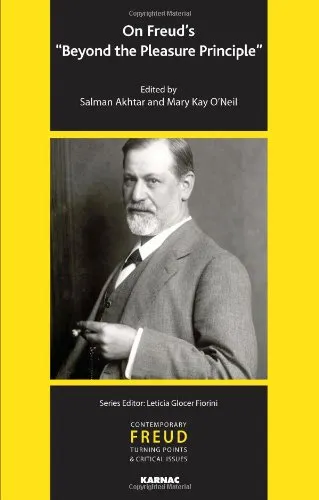
Welcome to a comprehensive exploration of "On Freud's 'Beyond the Pleasure Principle'," a critical text that delves into one of Sigmund Freud's most important yet enigmatic works. This book examines the profound insights Freud offers into human nature, psychological processes,
Before you read
Welcome to a comprehensive exploration of "On Freud's 'Beyond the Pleasure Principle'," a critical text that delves into one of Sigmund Freud's most important yet enigmatic works. This book examines the profound insights Freud offers into human nature, psychological processes, and the intriguing notion that life isn't driven solely by the pursuit of pleasure.
Authored by Salman Akhtar and Mary Kay O'Neil, "On Freud's 'Beyond the Pleasure Principle'" serves as an insightful companion to Freud’s seminal work. Originally published in 1920, Freud's "Beyond the Pleasure Principle" introduces revolutionary concepts that challenge the traditional psychoanalytic focus on human behavior being driven mostly by pleasure-seeking motives. Freud posits the existence of a compulsion to repeat certain behaviors and introduces the concept of a death drive, which presupposes an instinctual inclination towards destruction and a return to an inanimate state.
This book provides a thorough analysis of Freud’s text, breaking down complex ideas into comprehensible parts. It contextualizes Freud’s theories within both his earlier body of work and subsequent psychoanalytic thought. Further, Akhtar and O'Neil explore the transformative implications of these concepts on psychoanalysis and psychological treatment methodologies. They examine historical and cultural contexts, allowing readers to appreciate how Freud’s ideas have permeated various disciplines and continued to provoke debate and discussion.
Freud’s pioneering ideas, encapsulated in memorable quotes, continue to resonate:
"What appears in dreams, in active engagement with internal warfare and back edges which determine, in part, our behavioral repertoire, is not unambiguously a desire for pleasure."
"The interpretation of dreams is the royal road to a knowledge of the unconscious activities of the mind."
"On Freud's 'Beyond the Pleasure Principle'" holds tremendous importance in the realm of psychoanalysis and psychology. By exploring one of Freud's most daring assertions, Akhtar and O'Neil guide readers through a complex landscape of human motivations and instincts. The ideas presented have crossed disciplinary boundaries, influencing fields such as philosophy, literature, and cultural studies.
The book serves as an essential resource for psychologists, therapists, and scholars who seek to understand the intricate motivations behind human behavior. It invites readers to re-evaluate preconceived notions about pleasure, compulsion, and instinct, urging them to consider the less tangible forces shaping our actions and psyche. This exploration is not only vital for professionals in mental health but also enriches the broader discourse on human nature and existential motives.
Your question is answered in the context of this title and author. Each answer uses 2 points.
0 reviews, 4.0 average out of 5
Sign in to publish a review.
Ask a focused question and learn from the community.
Related references that continue this learning path.
Richard L. Drake;A. Wayne Vogl;Adam W.M. Mitchell



Aristides S Bouras,Loukia V Ainarozidou