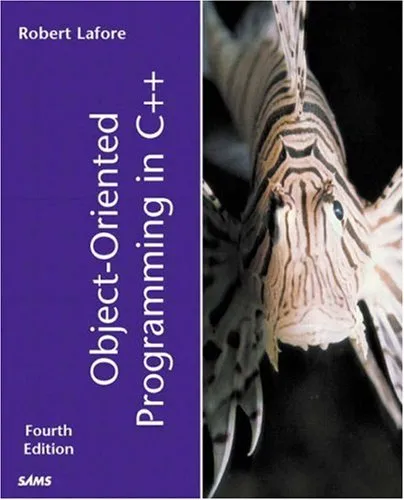
Book guide and evaluation
Object-oriented programming in C++
Robert Lafore
English
Intermediate
Programming Languages
4.6 / 5
0 reviews
2002
Published
1038
pages
679
views
Introduction to 'Object-Oriented Programming in C++' Delve into the world of C++ programming with 'Object-Oriented Programming in C++', a comprehensive guide designed to master the principles of modern programming through the lenses of object-oriented concepts. Detailed Sum
Before you read
What will you get from this book?
Introduction to 'Object-Oriented Programming in C++'
Delve into the world of C++ programming with 'Object-Oriented Programming in C++', a comprehensive guide designed to master the principles of modern programming through the lenses of object-oriented concepts.
Detailed Summary
The book 'Object-Oriented Programming in C++' serves as a detailed manual for both beginners and seasoned programmers who seek to deepen their understanding of object-oriented programming (OOP) principles using C++. This book aims to bridge the gap between fundamental programming concepts and advanced C++ techniques, ultimately providing a thorough and methodical approach to learning. The text is crafted to equip readers with a robust foundation in C++ programming while emphasizing OOP as a crucial paradigm in today's technology-centric world.
Starting with the basics, it meticulously describes the syntax, semantics, and intricacies of C++, offering a step-by-step introduction to variables, operators, control structures, and functions. Progressing through these foundations, the reader is then introduced to the key concepts of OOP, such as classes and objects, encapsulation, inheritance, and polymorphism.
Structured with precision, the book includes a range of exercises and examples that facilitate practical learning and ensure that the concepts are not only theoretically understood but are also applicable in real-world scenarios. Furthermore, the book introduces newer C++ standards, enriching the learning experience with contemporary programming practices.
Key Takeaways
- Grasp the fundamental concepts of C++ and understand their application in OOP.
- Master the four key principles of object-oriented programming: Encapsulation, Abstraction, Inheritance, and Polymorphism.
- Develop practical skills through hands-on examples and exercises that reinforce the theoretical understanding.
- Learn to write efficient, reusable, and maintainable code by applying best programming practices.
- Stay updated with modern programming standards and techniques in the evolving landscape of C++.
Famous Quotes from the Book
"Understanding the nuances of object-oriented programming transforms a coder into a software craftsman, one who is capable of weaving code into a tapestry of functional, scalable applications."
"C++ is not just a means to solve problems; it is a methodology that shapes the solution strategically while balancing efficiency and creativity."
Why This Book Matters
In the ever-evolving field of computer science and software engineering, proficiency in C++ and object-oriented programming is not merely advantageous but essential. This book matters because it offers a singular resource that thoroughly explains the integral aspects of OOP, making it possible to develop high-performance applications. The forward-thinking content that incorporates modern C++ standards puts learners at an advantage, ensuring that they remain competitive in the software development landscape.
Moreover, the accessible language and clear explanations make complex concepts approachable, demystifying challenging aspects of C++ programming. Whether you are a student in academia setting out on a programming career, a developer looking to expand your skillset, or an educator in need of a comprehensive teaching resource, 'Object-Oriented Programming in C++' provides invaluable insights and practical knowledge necessary for excelling in the world of programming.
Ask this book
Your question is answered in the context of this title and author. Each answer uses 2 points.
Sign in to ask the book assistant.
Reader reviews
0 reviews, 4.6 average out of 5
No reviews yet
If you have read this book, help the next reader with your experience.
Write a review
Sign in to publish a review.
Reader questions and answers
Ask a focused question and learn from the community.
Sign in to ask or answer a question.
No questions yet
Be the first to ask a clear, useful question.
What to read next
Related references that continue this learning path.