
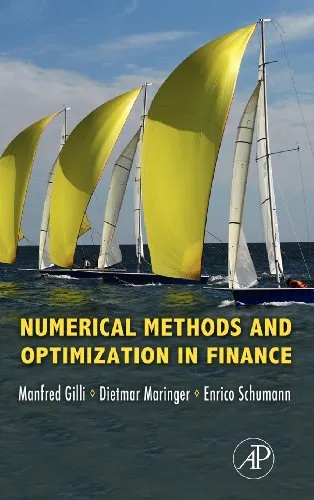
Numerical Methods and Optimization in Finance
Manfred Gilli,Dietmar Maringer,Enrico Schumann
English
Beginner
Economics
4.4 / 5
0 reviews
2011
Published
579
pages
256
views
Introduction to "Numerical Methods and Optimization in Finance" In today's fast-paced and complex financial markets, the ability to effectively analyze and solve quantitative problems is more crucial than ever. "Numerical Methods and Optimization in Finance" serves as a comple
Before you read
What will you get from this book?
Introduction to "Numerical Methods and Optimization in Finance"
In today's fast-paced and complex financial markets, the ability to effectively analyze and solve quantitative problems is more crucial than ever. "Numerical Methods and Optimization in Finance" serves as a complete resource to bridge the gap between financial theories and the computational techniques required for real-world practice. This book is an essential guide for finance professionals, academics, and students who seek to deepen their understanding of numerical methods while learning how to apply optimization techniques in finance.
Written by Manfred Gilli, Dietmar Maringer, and Enrico Schumann, this book brings together decades of expertise to build an intuitive yet rigorous framework for computation and modeling in finance. Whether you're dealing with portfolio optimization, risk management, derivative pricing, or complex market behavior, the methods and tools covered here are indispensable for solving modern problems in finance.
Detailed Summary of the Book
The book provides a structured introduction to numerical methods and optimization techniques, specifically tailored for financial applications. The authors cover a variety of topics, starting with the fundamental principles of numerical computation and advancing to complex optimization algorithms. The book's progression allows readers to build their knowledge gradually, making it suitable for beginners yet robust enough for seasoned practitioners.
It begins by laying the groundwork with essential concepts in numerical analysis, covering root-finding, linear algebra, and basic probability distributions. From there, readers are introduced to optimization, a core chapter that explores both deterministic and stochastic approaches. Real-world problems like portfolio optimization, risk management, and financial derivative valuation are used to illustrate the methodology in depth.
The authors emphasize practice over theory by presenting numerous examples and guiding readers through hands-on exercises. The practical focus is supported by pseudo-code and algorithms that are easy to implement in various programming environments, making this book an invaluable resource for quants, data scientists, and financial engineers.
Key Takeaways
- Comprehensive coverage of numerical methods tailored to the needs of financial applications.
- Detailed insights into optimization techniques, including evolutionary algorithms and heuristic methods.
- Practical examples and pseudocode that allow readers to implement solutions using common programming languages like R, Python, or Matlab.
- Chapters designed with gradual progression, suitable for both self-study and classroom use.
- Focus on real-world applications, addressing problems like option pricing, risk management, and portfolio selection.
Famous Quotes from the Book
"Optimization underpins many aspects of finance, from structuring portfolios to minimizing risk. To ignore it is to ignore the very core of quantitative decision-making."
"The synergy between numerical methods and financial theories is where innovation thrives in tackling real-world problems."
"Learning numerical methods is not just an academic exercise; it's an essential skill for anyone aiming to succeed in today's data-driven financial landscape."
Why This Book Matters
Financial markets are complex systems that require nuanced and precise tools for analysis and decision-making. Numerical methods provide the computational backbone for modern finance, enabling analysts to process massive data sets, simulate market scenarios, and derive actionable insights.
This book is uniquely valuable because it focuses on the interplay between computation and finance. It not only explains the mathematical underpinnings of key methods but also addresses practical implementation challenges. By doing so, it bridges the gap between theory and application, equipping readers with the skills they need to excel in quantitative finance.
For students, researchers, and practitioners alike, this book provides a solid foundation in the computational techniques that drive the finance industry forward. Its highly applicable content and clear explanations make it a timeless resource in both academic and professional settings.
With "Numerical Methods and Optimization in Finance," readers gain not just a guide to programming and computation but also a comprehensive understanding of how these tools are used to address real-world financial problems. In an era where data and analysis drive financial success, mastering these methods has never been more critical.
Ask this book
Your question is answered in the context of this title and author. Each answer uses 2 points.
Sign in to ask the book assistant.
Reader reviews
0 reviews, 4.4 average out of 5
No reviews yet
If you have read this book, help the next reader with your experience.
Write a review
Sign in to publish a review.
Reader questions and answers
Ask a focused question and learn from the community.
Sign in to ask or answer a question.
No questions yet
Be the first to ask a clear, useful question.
What to read next
Related references that continue this learning path.

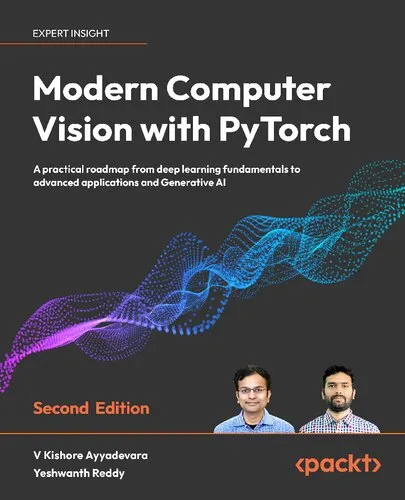
Modern Computer Vision with PyTorch: A Practical Roadmap From Deep Learning Fundamentals to Advanced Applications and Generative AI, 2nd Edition
V Kishore Ayyadevara,Yeshwanth Reddy
2023
View book