
Book guide and evaluation
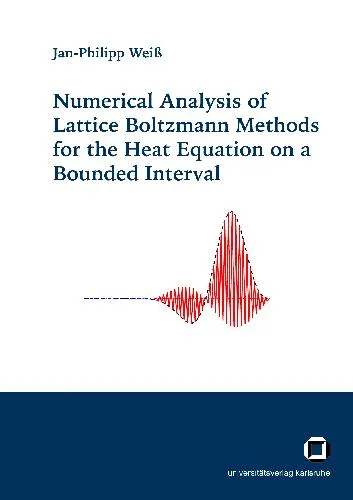
Numerical Analysis of Lattice Boltzmann Methods for the Heat Equation on a Bounded Interval
Weiß Jan-Philipp
English
Beginner
Mathematical Analysis
4.8 / 5
0 reviews
2006
Published
208
pages
573
views
Introduction Welcome to an insightful exploration of modern computational techniques with "Numerical Analysis of Lattice Boltzmann Methods for the Heat Equation on a Bounded Interval". This book is a comprehensive guide that delves into the synergy between numerical analysis a
Before you read
What will you get from this book?
Introduction
Welcome to an insightful exploration of modern computational techniques with "Numerical Analysis of Lattice Boltzmann Methods for the Heat Equation on a Bounded Interval". This book is a comprehensive guide that delves into the synergy between numerical analysis and lattice Boltzmann methods (LBMs), specifically addressing their application to solving the heat equation on bounded intervals.
Detailed Summary of the Book
In the scientific and engineering communities, the heat equation stands as a cornerstone for modeling thermal conductivity phenomena. Computational methods that efficiently solve such equations are in constant demand. The lattice Boltzmann method has emerged as a powerful tool due to its simplicity and parallelization potential. This book meticulously examines the application of LBMs to the heat equation, providing a robust bridge between theory and computational practice.
The text navigates through foundational concepts, beginning with a comprehensive introduction to the lattice Boltzmann method and its advantages over traditional numerical techniques. Readers are guided through the derivation of the method from kinetic theory principles and shown how it can be adapted to handle the complexities of bounded intervals. Central to this discussion is the analysis of boundary conditions and their treatment within the lattice Boltzmann framework.
Subsequent chapters delve deeper into numerical analysis aspects, leveraging stability and convergence theories. The treatment of these topics is both rigorous and accessible, making it suitable for researchers, graduate students, and professionals interested in numerical simulations of heat equations. The blend of theoretical insights and practical guidance equips readers with the know-how to implement LBMs efficiently within their computational models.
Key Takeaways
- Comprehensive Understanding: Gain an in-depth understanding of the lattice Boltzmann method's application in solving the heat equation.
- Numerical Analysis Techniques: Acquire knowledge about stability and convergence analyses crucial for numerical methods.
- Practical Implementation: Learn practical skills to implement LBMs in computational models effectively.
- Boundary Condition Treatments: Explore advanced techniques for handling boundary conditions within the LBM context.
Famous Quotes from the Book
"The elegance of the lattice Boltzmann method lies in its ability to transform complex differential equations into simple algebraic updates, paving the way for efficient computational solutions."
"Understanding the nuance of boundary conditions is not just an academic exercise; it is a necessity for the accurate simulation of physical phenomena."
Why This Book Matters
The lattice Boltzmann method, though relatively modern, has shown immense promise in various simulation contexts, including fluid dynamics and thermal analysis. By providing a clear and detailed exposition of LBMs applied to the heat equation, this book fills a significant gap in existing literature. It empowers readers to tackle complex thermal problems with confidence and precision, contributing to advancements in technology and science. Furthermore, the book's focus on bounded intervals brings a practical dimension, addressing real-world scenarios encountered in engineering and applied physics.
Ask this book
Your question is answered in the context of this title and author. Each answer uses 2 points.
Sign in to ask the book assistant.
Reader reviews
0 reviews, 4.8 average out of 5
No reviews yet
If you have read this book, help the next reader with your experience.
Write a review
Sign in to publish a review.
Reader questions and answers
Ask a focused question and learn from the community.
Sign in to ask or answer a question.
No questions yet
Be the first to ask a clear, useful question.
What to read next
Related references that continue this learning path.
Functional Equations and Inequalities: Solutions and Stability Results
K Ravi;B V Senthil Kumar;John Michael Rassias
2017
View book