Book guide and evaluation
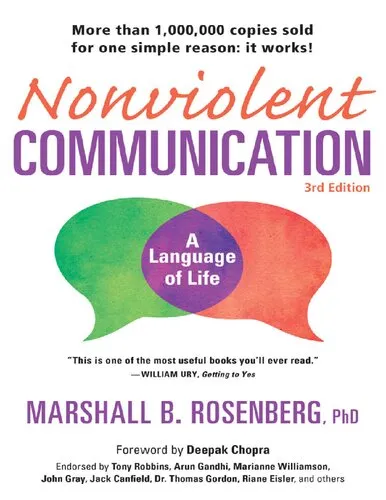
Nonviolent communication: A language of life
Rosenberg, Marshall B.,andDeepak Chopra
English
Intermediate
Personal Development
5.0 / 5
0 reviews
2015
Published
334
pages
550
views
Introduction to "Nonviolent Communication: A Language of Life" Welcome to an exploration of empathetic understanding and transformative dialogue with Marshall B. Rosenberg's profound work, Nonviolent Communication: A Language of Life. This book stands as a guiding beacon f
Before you read
What will you get from this book?
Introduction to "Nonviolent Communication: A Language of Life"
Welcome to an exploration of empathetic understanding and transformative dialogue with Marshall B. Rosenberg's profound work, Nonviolent Communication: A Language of Life. This book stands as a guiding beacon for fostering genuine compassion and peaceful exchange in our daily interactions. Here, we delve into a detailed overview, key takeaways, memorable quotes, and the significant impact this book has had globally.
Detailed Summary of the Book
In Nonviolent Communication: A Language of Life, Marshall B. Rosenberg introduces a communication process that cultivates understanding and compassion amid the challenges of modern life—whether in personal relationships, organizational settings, or across cultural divides. Rosenberg reveals how the way we think and communicate entrenches patterns of misunderstanding and conflict, and he offers strategies to overcome them through his meticulously designed nonviolent communication (NVC) technique.
The NVC process is built on four components: observations, feelings, needs, and requests. By clearly distinguishing these elements in conversation, individuals can better express themselves without blame or judgment, and in turn, better understand the sentiments and needs of others. Rosenberg's method underscores the importance of emotional intelligence and empathic listening to resolve conflicts and strengthen connections.
Central to his philosophy is the belief that all human beings have the capacity for compassion, and that language plays a fundamental role in altering how we relate to one another. The book explores practical applications of NVC in varied settings, from intimate personal exchanges to large scale social advocacy, underscoring its versatility and effectiveness in promoting harmony.
Key Takeaways
- Understanding and differentiating between Observations and Evaluations helps avoid judgments and conflict.
- Effectively expressing our feelings and needs is crucial for nurturing empathetic and respectful exchanges.
- Making requests instead of demands enhances cooperation and mutual respect.
- Empathic listening can transform conflicts into deeper collective understanding and connection.
- Practicing NVC empowers individuals to connect with each other on a human level, promoting kindness and compassion.
Famous Quotes from the Book
"The more we empathize with the other party, the safer we feel."
"Every criticism, judgment, diagnosis, and expression of anger is the tragic expression of an unmet need."
"What others do may be the stimulus of our feelings, but not the cause."
Why This Book Matters
In a world rife with conflict and misunderstanding, Nonviolent Communication: A Language of Life offers a framework for navigating communication with compassion and clarity. It matters because it equips individuals with tools to build healthier, more empathetic relationships on both personal and societal levels. Its principles can transform how communities address conflict by fostering environments where cooperation and understanding are prioritized over antagonism and division.
The book's influence extends beyond self-help; it's a philosophical shift towards perceiving and interacting with others through the lens of shared human experience. Whether enhancing intimate relationships, advancing conflict resolution in professional settings, or advocating for social change, Rosenberg's teachings prompt readers to consider the power of language as a vehicle for peace and understanding.
Ask this book
Your question is answered in the context of this title and author. Each answer uses 2 points.
Sign in to ask the book assistant.
Reader reviews
0 reviews, 5.0 average out of 5
No reviews yet
If you have read this book, help the next reader with your experience.
Write a review
Sign in to publish a review.
Reader questions and answers
Ask a focused question and learn from the community.
Sign in to ask or answer a question.
No questions yet
Be the first to ask a clear, useful question.
What to read next
Related references that continue this learning path.
Pragmatics of Human Communication: A Study of Interactional Patterns, Pathologies, and Paradoxes
Paul Watzlawick,Janet Helmick Beavin,Don D. Jackson
1967
View book
Surrounded by idiots: the four types of human behavior and how to effectively communicate with each in business (and in life)
Bradbury, Rod;Erikson, Thomas;Pender, Martin
2019
View book