

Book guide and evaluation
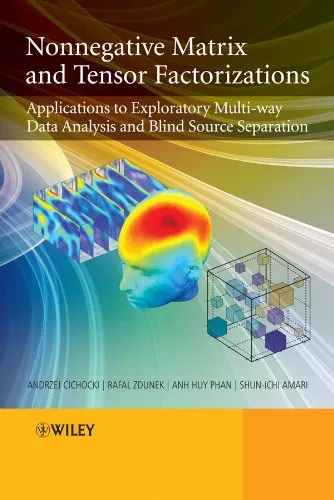
Nonnegative Matrix and Tensor Factorizations: Applications to Exploratory Multi-way Data Analysis and Blind Source Separation
Andrzej Cichocki,Rafal Zdunek,Anh Huy Phan,Shun-ichi Amari
English
Beginner
Physics
4.8 / 5
0 reviews
2009
Published
501
pages
201
views
Introduction "Nonnegative Matrix and Tensor Factorizations: Applications to Exploratory Multi-way Data Analysis and Blind Source Separation" is a comprehensive resource authored by Andrzej Cichocki, Rafal Zdunek, Anh Huy Phan, and Shun-ichi Amari. It serves as both a found
Before you read
What will you get from this book?
Introduction
"Nonnegative Matrix and Tensor Factorizations: Applications to Exploratory Multi-way Data Analysis and Blind Source Separation" is a comprehensive resource authored by Andrzej Cichocki, Rafal Zdunek, Anh Huy Phan, and Shun-ichi Amari. It serves as both a foundational guide and an advanced reference for those delving into nonnegative matrix and tensor factorization (NMF/NTF), techniques that have made significant strides in diverse fields such as machine learning, signal processing, bioinformatics, and beyond.
Nonnegative matrix and tensor factorizations refer to techniques that decompose data arrays into lower-dimensional representations while enforcing non-negativity constraints. This allows for interpretability, making these methods invaluable for exploratory data analysis and applications like feature extraction and blind source separation. The book provides detailed insights into theoretical underpinnings, algorithms, and practical applications of these methods.
Authored by leading experts, this book is structured to cater to both novices who are new to matrix/tensor factorization methods and experts requiring in-depth knowledge and advanced techniques. It bridges mathematical theory with real-world applications in fields like audio and image processing, neuroscience, and chemometrics. With this book, you'll not only grasp the fundamentals but also learn how to apply these techniques to uncover meaningful patterns and structures in complex datasets.
Detailed Summary of the Book
The book begins with an accessible introduction to NMF and NTF, outlining their mathematical foundations, historical evolution, and the key challenges tackled by these methods. It emphasizes the importance of imposing non-negativity to ensure that results remain interpretable by reflecting real-world quantities such as weights, intensities, and probabilities.
Core chapters are dedicated to different algorithms used for factorization, such as multiplicative updates, alternating least squares (ALS), and gradient descent methods. Each algorithm is accompanied by detailed explanations, derivations, and examples. The authors also delve into flexible extensions of these standard approaches, including sparsity constraints, smoothness regularizers, and hierarchical factorization methods.
The book highlights practical applications of NMF/NTF, demonstrating how these methods are utilized in diverse fields. From blind source separation to image decomposition, text mining, and even brain imaging, the authors illustrate how NMF/NTF supports exploratory data analysis and the extraction of meaningful patterns in multi-dimensional data.
Advanced sections provide insights into tensor factorizations and deal with higher-order data representations. This is particularly useful for readers working on time-series analysis, audio-visual data synthesis, and multi-source data analysis. The text also discusses state-of-the-art optimization approaches and software implementations.
Key Takeaways
Readers of this book will come away with several key insights:
- Comprehensive understanding of nonnegative matrix and tensor factorizations and their mathematical formulations.
- Ability to apply NMF/NTF techniques to real-world datasets for uncovering latent structures.
- Awareness of practical challenges, including regularization, scalability, and computational efficiency.
- Exposure to advanced topics in tensor factorization, particularly for high-dimensional data representations.
- Insight into the connections between NMF/NTF and other machine learning techniques such as clustering and dimensionality reduction.
- Practical knowledge of algorithms and implementations that facilitate the transition from theory to application.
Famous Quotes from the Book
Below are notable quotes that capture the essence of the book:
"Nonnegative factorization is not merely a computational tool; it is a way to make sense of the world, to discover hidden structures in data that are both meaningful and interpretable."
"The usefulness of nonnegative constraints lies in their ability to model real-world phenomena where negative values are either physically meaningless or hard to interpret."
"Exploratory data analysis with nonnegative matrix and tensor factorizations can transform raw, multi-way data into a clearer, human-interpretable format."
Why This Book Matters
The importance of this book in the scientific and data analysis community cannot be overstated. As datasets grow larger and more complex, finding efficient ways to extract meaningful insights becomes vital. Nonnegative matrix and tensor factorizations are indispensable tools for researchers and practitioners tackling real-world analytical challenges.
The book stands out because of its rigorous yet accessible treatment of the topic. It fills a critical gap by addressing both the theoretical principles behind NMF/NTF and their computational implementations. Furthermore, the emphasis on interpretability makes it a unique guide for anyone working in interdisciplinary fields where trust and understanding of results are paramount.
Whether you are a data scientist exploring hidden features in biological datasets, a signal processing engineer working on source separation, or a machine learning practitioner developing models for unstructured data, this book equips you with both the technical knowledge and tools to succeed. By incorporating rich examples and algorithmic guidance, the book is not just a reference but also a roadmap for modern multi-way data analysis.
In an era where data abundance can lead to analysis paralysis, "Nonnegative Matrix and Tensor Factorizations" matters because it empowers readers to transform raw complexity into actionable understanding.
Ask this book
Your question is answered in the context of this title and author. Each answer uses 2 points.
Sign in to ask the book assistant.
Reader reviews
0 reviews, 4.8 average out of 5
No reviews yet
If you have read this book, help the next reader with your experience.
Write a review
Sign in to publish a review.
Reader questions and answers
Ask a focused question and learn from the community.
Sign in to ask or answer a question.
No questions yet
Be the first to ask a clear, useful question.
What to read next
Related references that continue this learning path.


Modern Computer Vision with PyTorch: A Practical Roadmap From Deep Learning Fundamentals to Advanced Applications and Generative AI, 2nd Edition
V Kishore Ayyadevara,Yeshwanth Reddy
2023
View book