
Six Easy Pieces: Essentials of Physics Explained by Its Most Brilliant Teacher
Richard P. Feynman,Robert B. Leighton,Matthew Sands
2011
View book
Book guide and evaluation
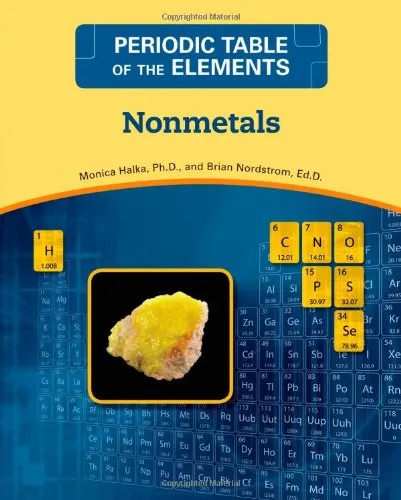
Monica,Ph.d. Halka,Brian Nordstrom
0 reviews
Published
pages
views
Introduction to "Nonmetals: Periodic Table of the Elements" Welcome to "Nonmetals: Periodic Table of the Elements," a dedicated exploration into the fascinating world of nonmetals. This book seeks to shine a spotlight on a group of elements that are as significant as they
Before you read
Welcome to "Nonmetals: Periodic Table of the Elements," a dedicated exploration into the fascinating world of nonmetals. This book seeks to shine a spotlight on a group of elements that are as significant as they are often overlooked. While the periodic table is filled with metallic elements that have captured much scientific attention, the nonmetals embody an equally compelling story. They are intrinsic to life itself, the foundation of biological processes, and integral components of some of the most groundbreaking technologies of our age. From the vital breath of oxygen to the structural versatility of carbon, each chapter in this book presents an in-depth discussion of the characteristics, behavior, and importance of nonmetals in science and industry.
Whether you are a student, a science enthusiast, or a professional chemist seeking a structured and thoughtful understanding of the periodic table's nonmetals, this book will serve as your comprehensive guide. Packed with a mix of historical anecdotes, modern applications, and scientific explanations, "Nonmetals: Periodic Table of the Elements" unravels the mysteries behind these indispensable chemical elements. Dive in to explore why the seemingly mundane building blocks of gases, brittle solids, and complex compounds are at the heart of everything from sustaining life on Earth to shaping a sustainable future.
This book begins with an overview of the periodic table's structure, illuminating how nonmetals are situated both literally and metaphorically within the broader context of chemistry and materials science. We then move into detailed individual chapters on each nonmetal, including hydrogen, helium, carbon, nitrogen, oxygen, fluorine, phosphorus, sulfur, and others. Through these chapters, you'll uncover their atomic properties, chemical behaviors, and the roles they play in various reactions and compounds. Special attention is given to nonmetals' biological importance—how nitrogen cycles through ecosystems, how oxygen fuels cellular respiration, and how carbon forms the backbone of all known life.
The book also takes a deep dive into the applications of nonmetals in technology, detailing their use in semiconductors, advanced coatings, and sustainable energy solutions like hydrogen fuel cells. Furthermore, you will gain insights into how nonmetals like sulfur and chlorine, which have often been associated with industry and environmental impact, are being innovatively repurposed for greener chemistry. Throughout the book, you will find a balance of theoretical chemistry blended with real-world applications, making it both a scientific and practical resource.
"Nonmetals are not just components of the periodic table; they are the lifeblood of chemistry, the elements that breathe life into equations."
"If metals are the skeleton of the technological world, nonmetals are its soul, shaping the future of sustainable chemistry and energy."
The importance of understanding nonmetals cannot be overstated. These elements are enablers of progress, deeply interwoven with the fabric of science, technology, and the environment. In the era of climate change and sustainability challenges, an informed understanding of nonmetals is pivotal for driving forward cutting-edge solutions. This book brings nonmetals into the spotlight, providing readers with a resource that is as academically rigorous as it is accessible. By highlighting their relevance, significance, and versatility, this book equips readers to appreciate and leverage nonmetals in addressing both everyday challenges and the grand problems of our time.
Your question is answered in the context of this title and author. Each answer uses 2 points.
0 reviews, 4.5 average out of 5
Sign in to publish a review.
Ask a focused question and learn from the community.
Related references that continue this learning path.
Richard P. Feynman,Robert B. Leighton,Matthew Sands