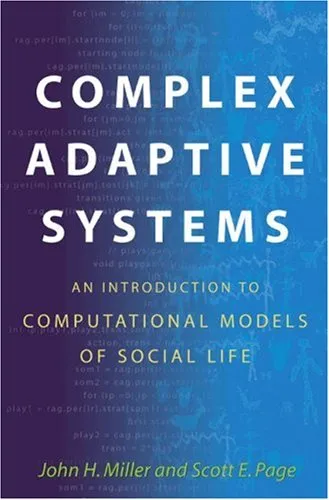
Complex Adaptive Systems: An Introduction to Computational Models of Social Life (Princeton Studies in Complexity)
John H. Miller,Scott E. Page
2007
View book
Book guide and evaluation
R. Ennis,G. McGuire
0 reviews
Published
pages
views
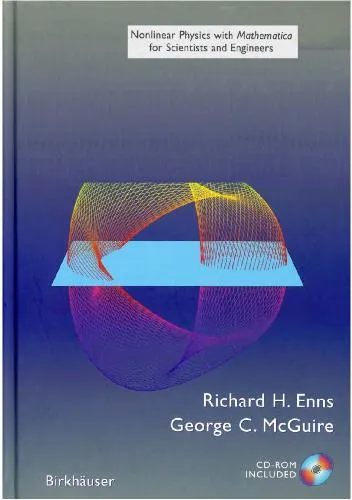
Introduction to Nonlinear Physics with Mathematica for Scientists and Engineers The world of nonlinear physics comes alive in this essential guide entwined with the powerful computational capabilities of Mathematica. This book, "Nonlinear Physics with Mathematica for Scien
Before you read
The world of nonlinear physics comes alive in this essential guide entwined with the powerful computational capabilities of Mathematica. This book, "Nonlinear Physics with Mathematica for Scientists and Engineers," is crafted for professionals, researchers, and students who seek to delve deeply into nonlinear systems and explore the profound solutions that these phenomena reveal when examined through sophisticated software tools.
This comprehensive text serves as both a textbook and reference manual for engaging with nonlinear physics, providing practical demonstrations using Mathematica. It covers a wide array of topics including chaos theory, fractals, solitons, and bifurcations, all explained using the robust computation environment Mathematica offers. Each chapter is designed to progress logically from fundamental concepts to more advanced topics, ensuring that readers can build a solid understanding before tackling more complex issues. The book includes numerous examples, figures, and exercises that apply Mathematica techniques to solve real-world nonlinear problems, thereby enhancing both theoretical understanding and practical computational skills.
Readers of this book will:
This book not only explains complex topics but also provides insightful commentary on the nature of nonlinear science. Here are a few quotes to inspire you:
"Nonlinear systems often possess simple descriptions but lead to unexpectedly rich and complex behavior."
"The beauty of nonlinear physics lies in its ability to refine our understanding that the most intricate phenomena can emerge from the simplest principles."
This book holds a significant place for several reasons. In today’s scientific landscape, understanding nonlinear dynamics is crucial across various disciplines, from predicting the weather to understanding market dynamics in economics. Nonlinear Physics with Mathematica provides a critical toolset for comprehending and analyzing this complexity through the use of a widely respected computational platform.
The text bridges a vital gap between theory and application, making it especially valuable for researchers and professionals who aim to apply nonlinear principles in practical scenarios. By integrating Mathematica into discussions of nonlinear physics, the book offers an indispensable resource for visualizing and harnessing the often counter-intuitive results of nonlinear models.
Furthermore, the book's approach to teaching, which emphasizes interaction, exploration, and direct application, aligns perfectly with educational best practices, ensuring that what is learned not only stays with the learner but is used dynamically in problem-solving situations.
Your question is answered in the context of this title and author. Each answer uses 2 points.
0 reviews, 4.6 average out of 5
Sign in to publish a review.
Ask a focused question and learn from the community.
Related references that continue this learning path.
John H. Miller,Scott E. Page