Ordinary Differential Equations with Applications to Mechanics
Mircea V. Soare,Petre P. Teodorescu,Ileana Toma (auth.)
2007
View book
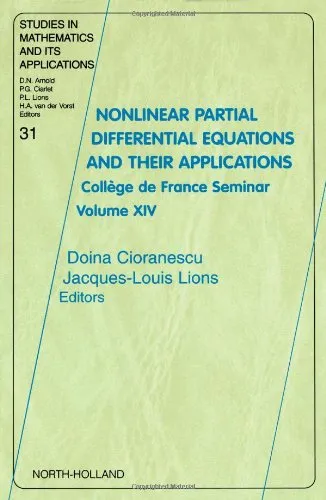
Book guide and evaluation
Doina CioranescuandJacques-Louis Lions (Eds.)
0 reviews
Published
pages
views
Introduction to "Nonlinear Partial Differential Equations and their Applications: Collège de France Seminar Volume XIV" The book "Nonlinear Partial Differential Equations and their Applications: Collège de France Seminar Volume XIV", edited by Doina Cioranescu and Jacque
Before you read
The book "Nonlinear Partial Differential Equations and their Applications: Collège de France Seminar Volume XIV", edited by Doina Cioranescu and Jacques-Louis Lions, represents an eminent academic contribution to the world of mathematics, specifically focused on nonlinear partial differential equations (PDEs) and their far-reaching applications. Originating from the prestigious seminars held at the Collège de France, this volume encapsulates cutting-edge studies, providing an insightful, dynamic, and interdisciplinary perspective on topics in PDE analysis. This book caters to both theoretical researchers and practical scientists dealing with nonlinear systems, making it a comprehensive and indispensable guide for the field.
Nonlinear partial differential equations form the bedrock of numerous scientific and engineering challenges. This volume meticulously discusses various topics such as existence, uniqueness, asymptotic behavior, and the interaction of solutions for nonlinear PDEs, alongside their roles in disciplines like physics, biology, and mechanics. The book stands as a testimony to the rigorous intellectual discourse at the Collège de France, showcasing contributions from world-renowned mathematicians who present the theoretical underpinnings while also emphasizing the applicability of these equations.
This volume is part of a prestigious series that consolidates original research insights discussed at the Collège de France seminars. Volume XIV brings together contributions from mathematicians addressing varied aspects of nonlinear PDEs. It covers fundamental problems such as the well-posedness of solutions, bifurcation theory, functional spaces adapted for nonlinear problems, and the behavior of boundary layer phenomena.
With a balanced mix of theoretical exploration and tangible application, each chapter brings a self-contained discussion, starting from the mathematical framework and extending to its implications in real-world systems. Topics include the Navier-Stokes equations, nonlinear wave equations, reaction-diffusion systems, and optimization methods influenced by PDEs. Whether readers are focused on deepening their technical expertise or exploring applications in domains like fluid dynamics, electromagnetism, or biomathematics, they are certain to find profound insights in this book.
"Nonlinear problems do not just complicate mathematical solutions; they challenge our understanding of the underlying physics of the universe."
"At the intersection of rigorous analysis and real-world applications lies the true beauty of mathematics, and nowhere is this more evident than in the study of nonlinear partial differential equations."
Mathematical research has long served as a vital pillar for advancements in science and technology, and this book exemplifies that tradition. Nonlinear PDEs underlie numerous critical processes, ranging from atmospheric dynamics to biological pattern formation, and their study has significantly advanced our capacity to model and predict complex systems.
This volume is not merely an academic text but a resource that bridges gaps between pure mathematics, computational techniques, and applied sciences. The discussions in this book provide step-by-step mathematical rigor while addressing contemporary challenges in fluid mechanics, elasticity, thermodynamics, and more. By reading it, mathematicians, physicists, and engineers alike gain access to insightful methods for tackling nonlinear phenomena.
In addition, the book places a significant emphasis on collaboration and interdisciplinary research, reflecting how mathematics interacts with other branches of science to solve global challenges. It matters now more than ever as mathematical modeling becomes increasingly indispensable in confronting the world's most pressing problems, including climate change, energy optimization, and epidemic modeling.
Your question is answered in the context of this title and author. Each answer uses 2 points.
0 reviews, 4.5 average out of 5
Sign in to publish a review.
Ask a focused question and learn from the community.
Related references that continue this learning path.
Mircea V. Soare,Petre P. Teodorescu,Ileana Toma (auth.)