Book guide and evaluation
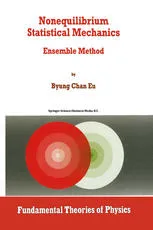
Nonequilibrium Statistical Mechanics: Ensemble Method
Byung Chan Eu (auth.)
English
Beginner
Thermodynamics
4.2 / 5
0 reviews
1998
Published
405
pages
463
views
Introduction to Nonequilibrium Statistical Mechanics: Ensemble Method Welcome to the immersive world of nonequilibrium statistical mechanics, where the elegance of theoretical physics meets the complexity of dynamic systems far from equilibrium. "Nonequilibrium Sta
Before you read
What will you get from this book?
Introduction to Nonequilibrium Statistical Mechanics: Ensemble Method
Welcome to the immersive world of nonequilibrium statistical mechanics, where the elegance of theoretical physics meets the complexity of dynamic systems far from equilibrium. "Nonequilibrium Statistical Mechanics: Ensemble Method" by Byung Chan Eu serves not only as an advanced academic endeavor but also as an enlightening journey for those who seek to fathom the nuances and depths of nonequilibrium states across a variety of systems.
Detailed Summary of the Book
The book delves into the fundamental concepts and methodologies of nonequilibrium statistical mechanics, providing a detailed analysis of ensemble methods and their applications. It begins with a foundational introduction to the concepts of statistical ensembles in equilibrium systems before progressively advancing into the nonequilibrium domain. By leveraging the ensemble method, the author illustrates complex processes and phenomena that traditional equilibrium statistical mechanics often overlooks.
Structured to facilitate a deep comprehension for researchers, students, and professionals, the book covers essential topics such as irreversible thermodynamics, transport phenomena, the linear response theory, and dynamical mean-field approaches. By embedding robust mathematical frameworks, it ensures that readers gain a solid grip on theoretical constructs while simultaneously applying these concepts to practical scenarios like fluid dynamics, chemical reactions, and material deformation processes.
Key Takeaways
One of the pivotal takeaways from the book is the understanding of how systems behave under non-equilibrium conditions, paving the way for advanced research and application in fields as diverse as chemical engineering, physics, and materials science. By mastering ensemble methods, readers can expect to:
- Comprehend the theoretical underpinnings of nonequilibrium statistical methods.
- Utilize ensemble approaches to model complex systems and predict their behavior under non-static conditions.
- Apply mathematical frameworks and theoretical models to real-world scenarios in various scientific and engineering domains.
Famous Quotes from the Book
"In the dance of particles and waves, equilibrium is the music—and nonequilibrium holds the unexplored rhythm."
"To grasp nonequilibrium is to step beyond the quintessence of stability and embrace the dynamic flux of reality."
Why This Book Matters
Nonequilibrium Statistical Mechanics: Ensemble Method stands as a critical contribution to the field of statistical mechanics, filling the void between equilibrium theories and the complexities of real-world dynamic systems. By providing a comprehensive guide to ensemble methods applied to nonequilibrium systems, this book serves as an invaluable resource for academics, industry professionals, and anyone seeking a profound understanding of advanced statistical mechanics.
In an era where technological advancements demand more precise modeling and understanding of material behavior, this work provides the fundamental tools and methodologies needed to address cutting-edge challenges in scientific research and engineering applications. Its importance lies not only in the knowledge it conveys but in its ability to inspire future generations of scientists and engineers to explore, innovate, and transform our understanding of the universe.
Ask this book
Your question is answered in the context of this title and author. Each answer uses 2 points.
Sign in to ask the book assistant.
Reader reviews
0 reviews, 4.2 average out of 5
No reviews yet
If you have read this book, help the next reader with your experience.
Write a review
Sign in to publish a review.
Reader questions and answers
Ask a focused question and learn from the community.
Sign in to ask or answer a question.
No questions yet
Be the first to ask a clear, useful question.
What to read next
Related references that continue this learning path.
![Cover of Concepts in Thermal Physics, Second Edition [2nd Ed] (Instructor Solution Manual, Solutions)](https://s3.refhub.ir/images/thumb/Concepts_in_Thermal_Physics__Second_Edition___16631.webp)