
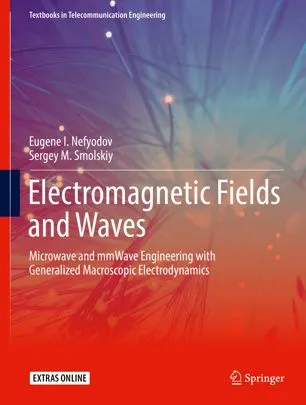
Electromagnetic Fields and Waves: Microwave and mmWave Engineering with Generalized Macroscopic Electrodynamics
Eugene I. Nefyodov,Sergey M. Smolskiy
2019
View book
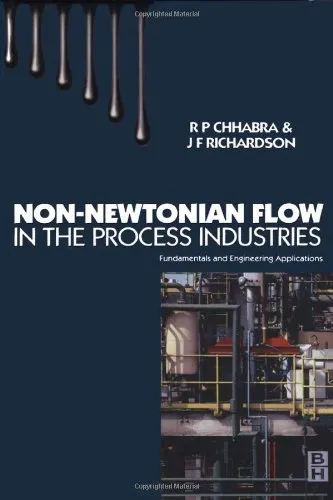
Book guide and evaluation
R. P. Chhabra,J.F. Richardson
0 reviews
Published
pages
views
Welcome to a detailed introduction to the seminal book "Non-Newtonian Flow in the Process Industries: Fundamentals and Engineering Applications", authored by R. P. Chhabra and J. F. Richardson. This book stands as a cornerstone in the field of fluid mechanics and process engine
Before you read
Welcome to a detailed introduction to the seminal book "Non-Newtonian Flow in the Process Industries: Fundamentals and Engineering Applications", authored by R. P. Chhabra and J. F. Richardson. This book stands as a cornerstone in the field of fluid mechanics and process engineering, meticulously addressing the behavior of non-Newtonian fluids and their applications in industrial environments. With a combination of foundational concepts, engineering insights, and real-world examples, this work is an indispensable resource for professionals, researchers, and students alike.
In the world of fluid dynamics, most introductory texts focus predominantly on Newtonian fluids—materials whose viscosity remains constant regardless of applied shear stress. However, many materials processed in industries, such as polymer melts, slurries, suspensions, and biological substances, exhibit non-Newtonian behavior in which their flow properties depend on factors like shear rate or time. This book dives deep into the science of non-Newtonian flow, providing clear explanations and a rigorous mathematical framework.
Part one of the book establishes fundamental concepts, including fundamental rheology and fluid classification. It explains the wide variety of non-Newtonian fluid types such as pseudoplastic, viscoplastic, and thixotropic substances, offering clarity on their differences and modeling techniques. The second part delves into specific process engineering applications, ranging from mixing and filtration to heat transfer and transport phenomena. Chhabra and Richardson integrate robust examples, calculations, and design considerations to elucidate how non-Newtonian properties impact industrial performance.
The material is presented in a systematic and lucid manner, suitable for both theoretical exploration and practical implementation. Its blend of academic depth and industrial relevance makes it a must-read for anyone involved in the design or optimization of chemical and manufacturing processes.
"The behavior of non-Newtonian fluids defies intuition, demanding an analytical and experimental approach to understand and manipulate the principles governing their motion."
"In process engineering, understanding the dynamics of non-Newtonian flow is not merely an intellectual exercise but a practical necessity for achieving operational excellence."
"The challenges posed by non-Newtonian materials lie not only in their complexity but in the opportunities they offer to innovate and optimize engineering systems."
As industries evolve, the materials used in processes are becoming increasingly complex. Non-Newtonian fluids are ubiquitous in sectors like chemical manufacturing, food processing, pharmaceuticals, and cosmetics. Without a thorough understanding of their behavior, engineers and designers risk inefficiencies, equipment failures, or suboptimal production outcomes.
This book bridges the gap between theoretical rheology and practical engineering, empowering readers to tackle real-world challenges. It provides insights essential for designing systems capable of handling high-viscosity or shear-sensitive materials, minimizing costs and maximizing productivity. Its emphasis on both fundamental concepts and applied knowledge ensures it remains relevant across disciplines and time.
By offering clarity and structure to an otherwise complex topic, "Non-Newtonian Flow in the Process Industries" has established itself as a foundational text for engineers seeking to understand fluid behavior beyond traditional Newtonian models.
Your question is answered in the context of this title and author. Each answer uses 2 points.
0 reviews, 4.5 average out of 5
Sign in to publish a review.
Ask a focused question and learn from the community.
Related references that continue this learning path.
Eugene I. Nefyodov,Sergey M. Smolskiy
Joseph F. White