
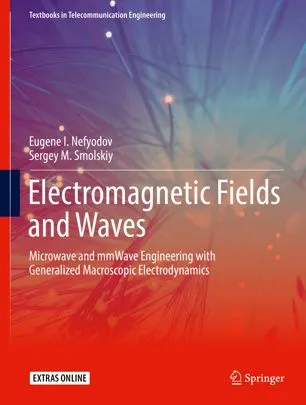
Electromagnetic Fields and Waves: Microwave and mmWave Engineering with Generalized Macroscopic Electrodynamics
Eugene I. Nefyodov,Sergey M. Smolskiy
2019
View book
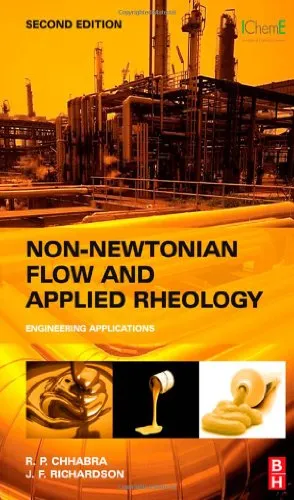
Book guide and evaluation
R. P. Chhabra,J.F. Richardson
0 reviews
Published
pages
views
Introduction to "Non-Newtonian Flow and Applied Rheology: Engineering Applications" The complexities of fluid mechanics reach beyond the standard assumptions of Newtonian behavior, and this is where Non-Newtonian fluid dynamics takes center stage. "Non-Ne
Before you read
The complexities of fluid mechanics reach beyond the standard assumptions of Newtonian behavior, and this is where Non-Newtonian fluid dynamics takes center stage. "Non-Newtonian Flow and Applied Rheology: Engineering Applications" serves as a comprehensive guide to the fascinating world of non-Newtonian fluids and their applications in engineering and real-world processes. With insights tailored for students, researchers, and practitioners, this book offers an in-depth exploration of the intricate behavior of non-Newtonian fluids, coupled with practical applications that demonstrate their significance across various industries.
Authored by R. P. Chhabra and J. F. Richardson, the book is meticulously written to bridge the gap between theoretical knowledge and engineering practice. It simplifies complex concepts while ensuring that readers can grasp the theoretical rigor behind them. Whether you're a chemical engineer, a materials scientist, or an industrial professional, this book offers the tools needed to tackle real-life challenges involving non-Newtonian flows.
The book begins by introducing the fundamental principles of rheology, which is the study of material deformation and flow. The authors delve into the characteristics that set non-Newtonian fluids apart from their Newtonian counterparts, such as their response to applied stress or strain rates. Readers are introduced to categories of non-Newtonian fluids, including shear-thinning, shear-thickening, viscoelastic, and yield-stress fluids.
Following the foundational concepts, the book transitions into practical aspects of flow and deformation in non-Newtonian fluids. Topics include mathematical modeling, analysis of flow behavior in diverse geometries, and stress-deformation relationships. The book emphasizes the importance of experimental data and rheometry in elucidating fluid behavior, offering detailed methodologies for measurement and interpretation.
Toward the latter chapters, the focus turns to applied engineering scenarios such as mixing, pipe flow, heat transfer, and polymer processing—all areas where non-Newtonian fluid dynamics are critically relevant. Case studies and solved examples throughout the book highlight real-world applications, such as in the food, chemical, pharmaceutical, and petroleum industries.
"Non-Newtonian fluids are not the exception, but rather the rule in engineering materials worldwide."
"Understanding the rheological behavior of materials is key to unlocking advancements across countless industrial sectors."
"The essence of non-Newtonian flow lies in its ability to challenge our traditional assumptions about material behavior."
With growing emphasis on material science and the increasing complexity of engineering problems, the ability to understand and utilize non-Newtonian fluids has never been more critical. From polymer processing to bioengineering, industries depend on the principles elucidated in this book to enhance product performance and optimize processes. The book not only equips readers with foundational knowledge but also instills an appreciation for the interdisciplinary nature of rheology and non-Newtonian fluid mechanics.
What sets "Non-Newtonian Flow and Applied Rheology" apart is its balanced approach. It caters equally to novices and experts in the field, layering fundamental concepts with cutting-edge research and practical applications. Its clarity, depth, and relevance make it a definitive resource for anyone seeking to make meaningful advancements in engineering applications involving complex fluids.
Your question is answered in the context of this title and author. Each answer uses 2 points.
0 reviews, 4.6 average out of 5
Sign in to publish a review.
Ask a focused question and learn from the community.
Related references that continue this learning path.
Eugene I. Nefyodov,Sergey M. Smolskiy
Joseph F. White