Book guide and evaluation
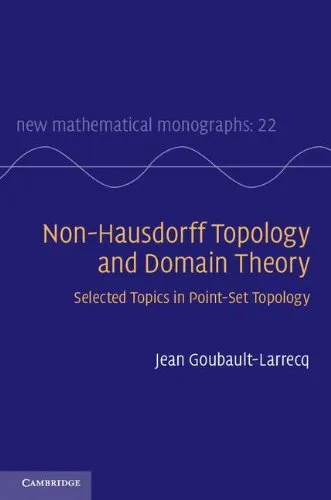
Non-Hausdorff Topology and Domain Theory: Selected Topics in Point-Set Topology
Jean Goubault-Larrecq
English
Beginner
Topology
4.5 / 5
0 reviews
2013
Published
500
pages
626
views
Introduction Welcome to the rich and intricate world of non-Hausdorff topology, where traditional boundaries and limits of classical topology are challenged and expanded. "Non-Hausdorff Topology and Domain Theory: Selected Topics in Point-Set Topolo
Before you read
What will you get from this book?
Introduction
Welcome to the rich and intricate world of non-Hausdorff topology, where traditional boundaries and limits of classical topology are challenged and expanded. "Non-Hausdorff Topology and Domain Theory: Selected Topics in Point-Set Topology" offers an in-depth exploration into the nuances of topologies that diverge from Hausdorff spaces, providing a substantial framework that includes applications to domain theory and computer science. This book serves both as an educational tool and a comprehensive reference for researchers, scholars, and graduate students who are delving into advanced concepts of topology and domain theory.
Detailed Summary of the Book
The book delves into various topics within non-Hausdorff topology, shedding light on its relevance and applicability in modern-day computational theories and practices. The initial chapters focus on foundational aspects, helping the reader to build a solid understanding of general topology. It offers a detailed examination of aspects such as Scott topology, Alexandroff spaces, and sobrification. While classical topology often prioritizes Hausdorff separation properties, this book opts for a broader perspective, enabling a more inclusive study of convergence, continuity, and compactness.
Further chapters explore domain theory’s intersections with theoretical computer science, focusing on the vital role topological notions play in the semantics of programming languages. Here, the reader is introduced to key concepts such as continuous lattices and dcpos (directed complete posets). These topics are approached with rigorous mathematical formalism, yet are made accessible through detailed explanations and examples. The book also provides insight into applications, including how non-Hausdorff topology can be an effective tool for analyzing computational processes.
Key Takeaways
- The book provides a comprehensive introduction to and exploration of offbeat topics in non-Hausdorff topology.
- It establishes the foundation for further study and potential research in domain theory and its implications in computer science.
- Readers will gain insight into how alternative topological structures can model computational and real-world phenomena.
- The text emphasizes the practical application of topology in analyzing the semantics of programming languages.
- An understanding of how non-classical topologies extend our comprehension of continuity and convergence in mathematical analysis.
Famous Quotes from the Book
"In the realm of mathematics, assumption and abstraction allow us to transcend traditional boundaries and explore new landscapes."
"Topological problematicity does not merely pose constraints; rather, it enriches our theoretical understanding and expands our methodological toolkit."
Why This Book Matters
Non-Hausdorff topology, though less prevalent in introductory studies, is essential for a complete understanding of the mathematical universe. This book opens up the vast, yet often overlooked, domain of non-Hausdorff spaces, offering key insights into their utility and excitement. For computer scientists, especially those interested in the theory behind programming languages and computational semantics, this book provides critical concepts and frameworks that connect topology with practical applications. Additionally, by challenging the preconceived notions of classical topology, the book encourages an innovative and critical mindset, a necessary trait for both mathematicians and scientists.
In conclusion, "Non-Hausdorff Topology and Domain Theory" is more than just a textbook; it is a gateway to a world of abstract thought and its tangible implications. Whether you are a budding mathematician, a seasoned computer scientist, or an inquisitive thinker delving into the layers of theoretical possibilities, this book is an essential resource that will inform, challenge, and inspire.
Ask this book
Your question is answered in the context of this title and author. Each answer uses 2 points.
Sign in to ask the book assistant.
Reader reviews
0 reviews, 4.5 average out of 5
No reviews yet
If you have read this book, help the next reader with your experience.
Write a review
Sign in to publish a review.
Reader questions and answers
Ask a focused question and learn from the community.
Sign in to ask or answer a question.
No questions yet
Be the first to ask a clear, useful question.
What to read next
Related references that continue this learning path.