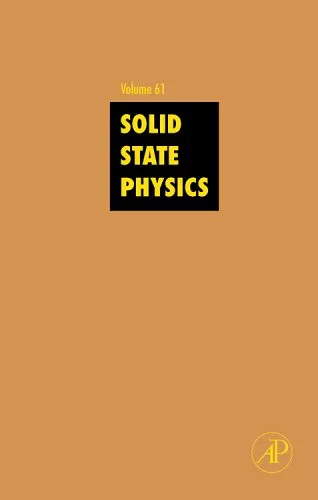
Solid State Physics: Advances in Research and Applications
Henry EhrenreichandFrans Spaepen (Eds.)
2009
View book
Book guide and evaluation
M.A. Popescu
0 reviews
Published
pages
views
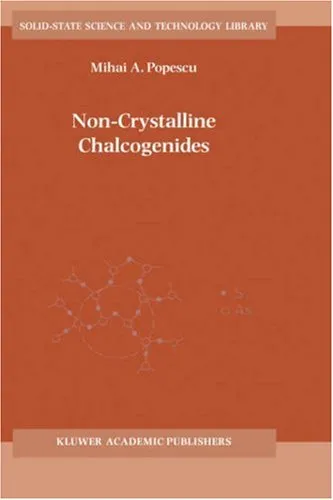
Introduction Welcome to the expansive and detailed world of Non-Crystalline Chalcogenides, a seminal work in the domain of solid-state science. As Volume 8 of the Solid-State Science and Technology Library, this book serves as a comprehensive guide, delving into th
Before you read
Welcome to the expansive and detailed world of Non-Crystalline Chalcogenides, a seminal work in the domain of solid-state science. As Volume 8 of the Solid-State Science and Technology Library, this book serves as a comprehensive guide, delving into the complex yet fascinating realm of non-crystalline chalcogenide materials. It is designed for scholars, researchers, and students who aspire to deepen their understanding of these unique compounds, offering a scholarly guide that combines theoretical analyses with pragmatic applications.
This book provides an extensive overview of non-crystalline chalcogenides, which are typically composed of sulfur, selenium, and tellurium. It examines the theoretical frameworks and methodologies employed in the study of these materials, discussing their electrical, optical, and structural properties. The focus is on understanding how the disordered nature of these materials affects their physical properties and potential applications.
A highlight of the book is its meticulous discussion on the synthesis and characterization techniques used in the field. Through a series of well-structured chapters, the text elucidates various experimental methods, such as Raman spectroscopy and X-ray diffraction, instrumental in uncovering the subtleties of non-crystalline structures. Furthermore, it explores cutting-edge applications in electronics, from memory storage solutions to optoelectronic devices, illustrating the dynamic capabilities of chalcogenide materials.
“The beauty of non-crystalline chalcogenides lies in their complexity and the promise they hold for future technological breakthroughs.”
“These materials, though seemingly disordered, possess an intrinsic order that speaks to the fundamental principles of amorphous science.”
Non-Crystalline Chalcogenides is a crucial text in understanding the evolving landscape of materials science. At a time when the world is increasingly reliant on high-performance materials for technological advancement, this book stands out by offering a deep dive into a class of materials that defy traditional crystalline paradigms. Its insights pave the way for new innovations, suggesting the potential reshaping of industries reliant on advanced material technologies.
Furthermore, the book not only grounds readers in the theoretical aspects but also offers practical implications, catering to those engaged in applied research. As a result, it serves as both an educational resource and a launchpad for innovation, bridging the gap between academia and industry.
By exploring the intersection of disorder and functionality, this work invites readers to rethink the role of amorphous materials in science and technology, underlining their potential to revolutionize the future of many applications.
Your question is answered in the context of this title and author. Each answer uses 2 points.
0 reviews, 4.8 average out of 5
Sign in to publish a review.
Ask a focused question and learn from the community.
Related references that continue this learning path.
Henry EhrenreichandFrans Spaepen (Eds.)