

Book guide and evaluation
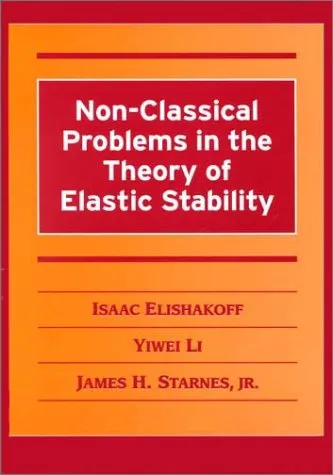
Non-Classical Problems in the Theory of Elastic Stability
Isaac Elishakoff,Yiwei Li,James H. Starnes Jr
English
Beginner
Mathematics
4.6 / 5
0 reviews
2001
Published
352
pages
204
views
Welcome to the comprehensive introduction to “Non-Classical Problems in the Theory of Elastic Stability”, an influential book authored by Isaac Elishakoff, Yiwei Li, and James H. Starnes Jr. This landmark text addresses unconventional and emerging challenges in the field of
Before you read
What will you get from this book?
Welcome to the comprehensive introduction to “Non-Classical Problems in the Theory of Elastic Stability”, an influential book authored by Isaac Elishakoff, Yiwei Li, and James H. Starnes Jr. This landmark text addresses unconventional and emerging challenges in the field of elastic stability, an area that significantly impacts engineering, design, and material science. By combining classical theories with modern approaches to real-world problems, this book offers both a profound theoretical foundation and practical solutions to stability-related issues often overlooked in traditional literature.
Summary of the Book
The book delves into the complex and dynamic world of elastic stability, extending beyond the boundaries of classical theories. Rather than confining itself to well-established methodologies for analyzing the stability of structures, this work illuminates the "non-classical" problems that arise due to modern engineering challenges. Topics include but are not limited to, stability problems influenced by material imperfections, dynamic loading conditions, stochastic properties, and non-linear behaviors in structural systems.
Structured to bridge the gap between foundational concepts and cutting-edge discoveries, the book begins by revisiting classical stability concepts while seamlessly transitioning to more intricate and rarer cases faced in contemporary practice. Issues such as asymmetrical loading, probabilistic analysis of elastic systems, and non-traditional boundary conditions are thoroughly explored. Each chapter is replete with detailed explanations, mathematical rigor, and illustrative examples to aid in understanding.
Scholars, engineers, and anyone interested in structural mechanics will find invaluable insights into diverse scenarios like thin-walled structures, space frame buckling, and the modeling of uncertainties in stability analyses. Furthermore, the text emphasizes computational techniques and experimental validations to ensure the practical applicability of the theoretical advancements discussed.
Key Takeaways
- Gain a nuanced understanding of elastic stability and its extension to non-classical systems, including stochastic, dynamic, and non-linear cases.
- Understand the critical role of imperfections and uncertainties in influencing structural stability.
- Learn advanced computational methods and their role in predicting stability and designing resilient systems.
- Explore practical examples of non-classical stability problems in contemporary engineering and material science.
- Develop a capability to address emerging challenges in structural stability, moving beyond traditional analytical techniques.
Famous Quotes from the Book
"The margin of safety in engineering design lies not in the perfection of materials, but in the accurate understanding and anticipation of imperfections."
"Stability is not merely a problem of the present equilibrium state but an inquiry into the possible deviations and their unforeseen implications."
"Engineering against instability requires a confluence of theoretical rigor and empirical adaptability."
Why This Book Matters
“Non-Classical Problems in the Theory of Elastic Stability” stands out as a pivotal contribution to structural mechanics and engineering sciences. Conventional stability analyses, while invaluable, often neglect critical factors such as non-linear responses, imperfections, and stochasticity—all of which are integral to modern industrial applications. This book addresses such gaps with unparalleled mathematical depth and practical relevance, making it a must-read for advanced students, researchers, and professionals.
Moreover, as technological advancement introduces new materials, configurations, and loading conditions, the demand for a more robust understanding of structural stability has skyrocketed. Elishakoff, Li, and Starnes Jr. rise to this challenge by offering not only theoretical insights but also tools and techniques to implement these concepts in the design and analysis of real-world systems. In an era of uncertainty and rapid innovation, this book equips readers with a versatile approach to tackling challenges in elastic stability, enhancing both safety and performance in engineering design.
Whether you are an academic seeking to expand the boundaries of structural analysis or an engineer striving for more reliable and efficient design processes, this book provides the intellectual and practical foundation you need.
Ask this book
Your question is answered in the context of this title and author. Each answer uses 2 points.
Sign in to ask the book assistant.
Reader reviews
0 reviews, 4.6 average out of 5
No reviews yet
If you have read this book, help the next reader with your experience.
Write a review
Sign in to publish a review.
Reader questions and answers
Ask a focused question and learn from the community.
Sign in to ask or answer a question.
No questions yet
Be the first to ask a clear, useful question.
What to read next
Related references that continue this learning path.


Modern Computer Vision with PyTorch: A Practical Roadmap From Deep Learning Fundamentals to Advanced Applications and Generative AI, 2nd Edition
V Kishore Ayyadevara,Yeshwanth Reddy
2023
View book