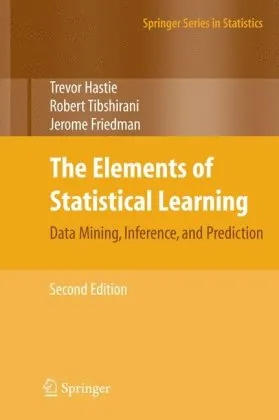
The elements of statistical learning: Data mining, inference, and prediction
Trevor Hastie,Robert Tibshirani,Jerome Friedman
2009
View book
Book guide and evaluation
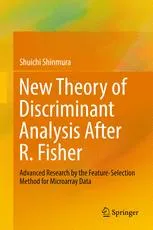
Shuichi Shinmura (auth.)
0 reviews
Published
pages
views
Introduction Welcome to a profound exploration of advanced research methodologies in discriminant analysis, as presented in "New Theory of Discriminant Analysis After R. Fisher: Advanced Research by the Feature Selection Method for Microarray Data". This book provides a si
Before you read
Welcome to a profound exploration of advanced research methodologies in discriminant analysis, as presented in "New Theory of Discriminant Analysis After R. Fisher: Advanced Research by the Feature Selection Method for Microarray Data". This book provides a significant leap forward from the pioneering work of Ronald Fisher, diving into the intricacies of modern statistical techniques used in the analysis of complex datasets, particularly microarray data.
The book ventures beyond traditional boundaries, offering a comprehensive examination of discriminant analysis techniques adapted for use with high-dimensional data, such as that found in microarrays. Microarrays have become a staple in genomics, requiring sophisticated methods to tackle the challenges posed by the vast amount of data they generate. In this context, the book serves as a definitive guide for researchers seeking to refine their analytical methodologies in the light of contemporary challenges.
The progression from R. Fisher's initial developments to current advancements is a central theme, as the book breaks down complex statistical concepts into accessible narratives. It systematically covers feature selection methods, which are crucial for handling the overwhelming number of variables present in microarray datasets. By emphasizing the selection of significant features, the book enhances the precision and interpretability of discriminant analysis results.
The intricacies of developing and validating reliable models are unpacked through various chapters, which emphasize practical applications and case studies. This approach not only solidifies theoretical understanding but also equips readers with the tools necessary for practical implementation and experimentation.
"The advancement of statistical methodology must evolve in tandem with the complexity of data, ensuring that our analytical tools are both robust and adaptive."
"In the era of 'big data', discerning the significant from the noise is the scientist's foremost challenge and greatest opportunity."
In an age where data permeates every aspect of scientific inquiry, the ability to critically analyze and draw meaningful conclusions from large datasets is invaluable. This book not only updates the foundational principles laid down by R. Fisher but also integrates modern computational techniques, bringing discriminant analysis into the contemporary data landscape.
It is particularly significant for professionals and researchers dealing with microarray data, a field where traditional statistical methods often fall short due to the sheer volume and complexity of information. Through this work, readers are equipped with cutting-edge techniques that enhance their analytical arsenal, allowing for more accurate and insightful research outcomes.
Moreover, the emphasis on feature selection embodies a paradigm shift towards more efficient data analysis strategies, where computational burden is reduced, interpretability is enhanced, and results are more reliable.
This book is more than just a technical manual; it is a bridge between statistical theory and practical application, ensuring that the advancements in discriminant analysis are accessible and applicable to current and future challenges in data science.
Your question is answered in the context of this title and author. Each answer uses 2 points.
0 reviews, 4.3 average out of 5
Sign in to publish a review.
Ask a focused question and learn from the community.
Related references that continue this learning path.
Trevor Hastie,Robert Tibshirani,Jerome Friedman
Gareth James,Daniela Witten,Trevor Hastie,Robert Tibshirani