
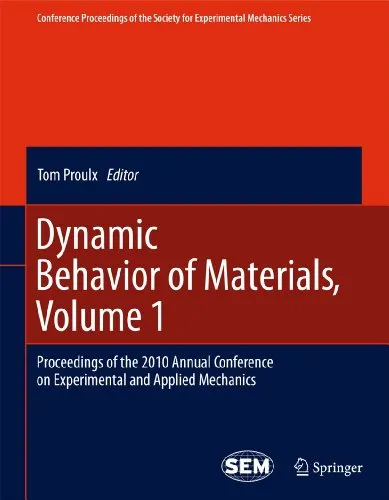
Dynamic Behavior of Materials, Volume 1: Proceedings of the 2010 Annual Conference on Experimental and Applied Mechanics
Weinong W. Chen (auth.),Tom Proulx (eds.)
2011
View book
Book guide and evaluation
Cameron Tropea,Suad Jakirlic,Hans-Joachim Heinemann,Rolf Henke,Heinz Honlinger
0 reviews
Published
pages
views
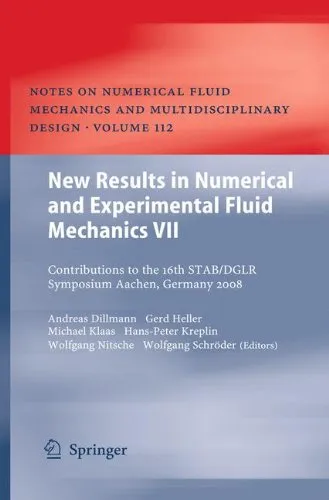
Introduction to "New Results in Numerical and Experimental Fluid Mechanics VI" "New Results in Numerical and Experimental Fluid Mechanics VI: Contributions to the 15th STAB DGLR Symposium Darmstadt, Germany 2006" is an integral compilation of cutting-edge research insights
Before you read
"New Results in Numerical and Experimental Fluid Mechanics VI: Contributions to the 15th STAB DGLR Symposium Darmstadt, Germany 2006" is an integral compilation of cutting-edge research insights into the ever-evolving field of fluid mechanics. Part of the esteemed "Notes on Numerical Fluid Mechanics and Multidisciplinary Design" series, Volume VI provides a profound platform for scientists, researchers, and engineers to delve into the contemporary methodologies and breakthroughs shaping both numerical and experimental fluid mechanics.
This book presents the contributions shared during the 15th Symposium of the German Aerospace Research Association (STAB) held in Darmstadt, Germany, in 2006. With 15 years of history, STAB has consistently encouraged discussions on the latest advancements in aerospace and fluid dynamics. Volume VI is no exception, encompassing papers and presentations that reflect a harmonious blending of numerical simulations, experimental data, and cross-disciplinary approaches integral to modern engineering and science.
The book is divided into several sections, addressing various fundamental and applied aspects of fluid mechanics, making it essential reading for academics and industry professionals alike. These sections collectively reflect the ongoing synergy between numerical and experimental methods, emphasizing both their complementary roles and their continuous evolution.
Key subjects include turbulence modeling, aerodynamic performance assessment, flow control techniques, and experimental methodologies, complemented by innovative numerical simulation tools. The integration of computational fluid dynamics (CFD) and experimental validation has been a recurring highlight, showcased through papers that deal with practical applications in aerospace technology and other industries.
Contributions also dive into examining flow phenomena in complex geometries, multi-scale simulation techniques, and refined turbulence models for improving predictive capabilities. By extending this focus to multidisciplinary design and optimization, the book proposes new approaches to solving real-world engineering challenges efficiently.
"The interplay between numerical and experimental techniques is the cornerstone of progress in fluid dynamics, where innovation emerges from their confluence."
"Fluid mechanics transcends fundamental science—it is the lifeblood of engineering practice, enabling breakthroughs in transportation, energy, and beyond."
"New Results in Numerical and Experimental Fluid Mechanics VI" serves as an intellectual cornerstone in fluid mechanics, solidifying its importance for researchers, academicians, and professionals. It provides a unique blend of theoretical insights, practical examples, and multidisciplinary perspectives, making it highly relevant for contemporary engineering challenges.
In a world where technology is advancing at an unparalleled rate, advancements in fluid mechanics hold significant promise for addressing environmental challenges, enhancing transportation efficiency, and pioneering aerospace designs. This book contributes to this vision by bridging scientific inquiry with actionable solutions, fueling progress across industries.
Furthermore, the meticulous documentation of proceedings from the esteemed STAB Symposium ensures that this work is not only scientifically rigorous but also representative of collaborative, peer-reviewed knowledge in the field. Its dedication to advancing numerical and experimental methodologies ensures its lasting relevance for decades to come.
Your question is answered in the context of this title and author. Each answer uses 2 points.
0 reviews, 4.0 average out of 5
Sign in to publish a review.
Ask a focused question and learn from the community.
Related references that continue this learning path.
Weinong W. Chen (auth.),Tom Proulx (eds.)
Daniel Knorr,Andrew Schoch,Joseph L. Lenhart (auth.),Vijay Chalivendra,Bo Song,Daniel Casem (eds.)
Daniel O. Odoh,Gbadebo M. Owolabi (auth.),Bo Song,Dan Casem,Jamie Kimberley (eds.)
W. Hübner,C. Tropea,J. Volkert (auth.),R. J. Adrian,D. F. G. Durão,F. Durst,M. V. Heitor,M. Maeda,J. H. Whitelaw (eds.)