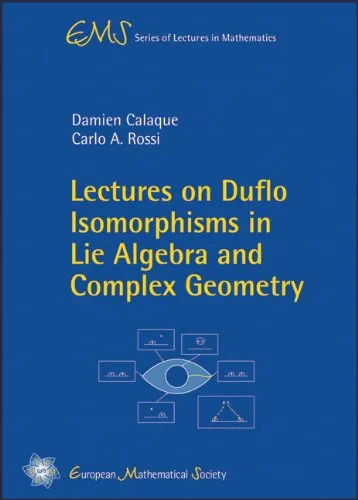
Lectures on Duflo Isomorphisms in Lie Algebra and Complex Geometry (EMS Series of Lectures in Mathematics)
Damien Calaque,Carlo A. Rossi
2011
View book
Book guide and evaluation
Susan Montgomery
0 reviews
Published
pages
views
Welcome to the world of algebraic structures where 'New Directions in Hopf Algebras' serves as a compass guiding readers through the intricate landscapes of Hopf algebras. Edited by Susan Montgomery and released under the Mathematical Sciences Research Institute's publicati
Before you read
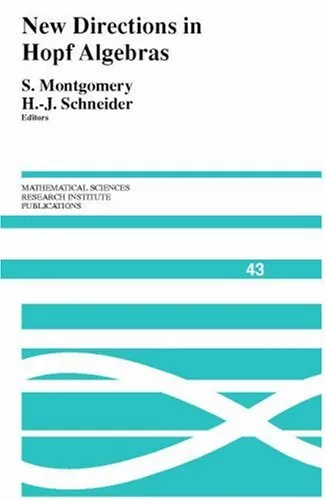
Welcome to the world of algebraic structures where 'New Directions in Hopf Algebras' serves as a compass guiding readers through the intricate landscapes of Hopf algebras. Edited by Susan Montgomery and released under the Mathematical Sciences Research Institute's publications, this seminal work delves into contemporary advancements, theoretical expansions, and practical applications pertaining to Hopf algebras.
'New Directions in Hopf Algebras' encompasses a comprehensive exploration of the mathematical framework that underlies many significant structures in algebra and geometry. The book is a collection of essays and articles that reflect recent research advancements, providing an authoritative overview of topics such as quantum groups, algebraic geometry connections, and combinatorial aspects. It serves as both a starting point for newcomers to the field and a substantial resource for seasoned researchers. Each chapter is intricately linked to the overall theme, building upon the pioneering work of previous algebraic scholars and setting the stage for future inquiries.
The contents unfold through a series of well-structured chapters focusing on various aspects of Hopf algebra theory. Discussions are posed within the context of coalgebras and bialgebras, encompassing both classical perspectives and modern interpretations. The text delves into detailed case studies which illustrate the real-world applicability of abstract concepts in understanding algebraic operations and symmetries. Through the intersection of numerous mathematical theories, readers gain insights into the potential for future research directions and applications in diverse fields such as physics and computer science.
"Hopf algebras form the backbone of understanding mathematical symmetries, offering an elegant synthesis of algebraic structures."
"New pathways in Hopf algebra research continue to illuminate the intersection of mathematics with physics and computer science."
'New Directions in Hopf Algebras' stands out as a critical contribution to the field of mathematics due to its synthesis of classical theory and modern advancements. Notably, it emphasizes the relevance of Hopf algebras beyond pure mathematics by highlighting applications in physics, engineering, and computer science. This inter-disciplinarity is paramount in today’s increasingly integrated scientific landscape.
Additionally, the book bridges gaps between different branches of mathematics, fostering a more unified understanding of algebraic principles. By compiling research from leading experts in the field and translating complex ideas into comprehendible narratives, it renders advanced mathematical concepts accessible for academia and industry alike.
Ultimately, this publication is vital for individuals seeking to deepen their knowledge in algebra, explore new research opportunities, or apply mathematical theory to interdisciplinary fields. It serves as a testament to the continuous evolution of mathematical innovation and the perpetual quest for understanding the fundamental nature of reality through algebraic structures.
Your question is answered in the context of this title and author. Each answer uses 2 points.
0 reviews, 4.5 average out of 5
Sign in to publish a review.
Ask a focused question and learn from the community.
Related references that continue this learning path.
Damien Calaque,Carlo A. Rossi