
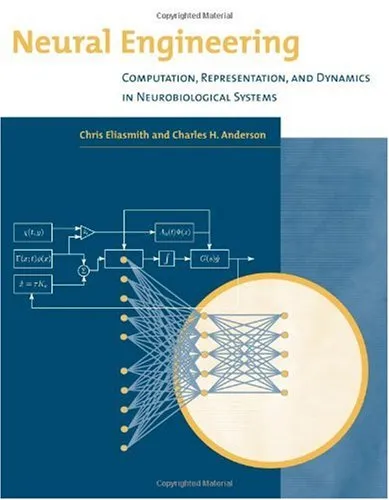
Book guide and evaluation
Neural engineering: computation, representation, and dynamics in neurobiological systems
Chris Eliasmith,C. H. Anderson
English
Beginner
Classical Mechanics
4.5 / 5
0 reviews
2003
Published
377
pages
415
views
Introduction to "Neural Engineering: Computation, Representation, and Dynamics in Neurobiological Systems" Embarking on a journey through the fascinating world of neural engineering, this book offers an in-depth exploration of computation, representation, and dynamics in n
Before you read
What will you get from this book?
Introduction to "Neural Engineering: Computation, Representation, and Dynamics in Neurobiological Systems"
Embarking on a journey through the fascinating world of neural engineering, this book offers an in-depth exploration of computation, representation, and dynamics in neurobiological systems. Authored by Chris Eliasmith and C. H. Anderson, the text delves into understanding the intersection of neuroscience and engineering, organically intertwining theory with practical applications to address complex questions about the brain.
Summary of the Book
The book, "Neural Engineering," presents a comprehensive framework for understanding how the brain computes, represents, and processes information. Through the lens of neuroscience and engineering, it seeks to address how neurons can be used to build brain-like systems capable of executing various cognitive functions. Starting with foundational concepts in neuroscience, it transitions into discussions about computational models and neural dynamics, systematically constructing a framework that bridges biological systems and artificial constructs.
The authors elaborate on methods for modeling neural systems using engineering principles, employing mathematical tools to simulate brain functions and incorporating neural coding as a pivotal concept in understanding information processing. By elucidating principles like spiking neurons and population coding, the text offers avenues for conceptualizing how complex behaviors arise from neuronal ensembles.
Key Takeaways
- Understanding the basic principles of neural computation and representation provides insights into functioning brain models, potentially influencing AI development.
- The book emphasizes the design and use of neural models informed by biological plausibility and mathematical rigor.
- It covers concepts like neural coding, spiking neurons, and network dynamics with clear explanations and supportive examples, making it relevant for both students and professionals in neuroscience and neural engineering.
- Neurobiological systems can be comprehended better through interdisciplinary approaches, combining aspects of biology with computational technology.
Famous Quotes from the Book
"In neural engineering, discerning the bridge between biology and computation is crucial for unraveling the intricacies of the mind."
"Neurons are not merely the messengers of the brain, but its architects, shaping perception and action through complex biological design."
Why This Book Matters
This book is seminal in its approach to blending neuroscience with engineering principles, making it indispensable in the evolving field of neural engineering. By demystifying the core processes of neural computation and the principles underlying biological systems, it becomes an essential resource for understanding how technological innovations can be inspired by and integrated into biological frameworks. The ideas presented in this text have far-reaching implications not only for advancing biomedical research and neuroprosthetics but also for influencing the development of artificial intelligence systems that mimic human cognition.
For students, researchers, and practitioners keen on exploring the convergence of biological intelligence and computational systems, this book lays down a robust foundation and encourages further exploration into the dynamic world of neurobiology and engineering.
Ask this book
Your question is answered in the context of this title and author. Each answer uses 2 points.
Sign in to ask the book assistant.
Reader reviews
0 reviews, 4.5 average out of 5
No reviews yet
If you have read this book, help the next reader with your experience.
Write a review
Sign in to publish a review.
Reader questions and answers
Ask a focused question and learn from the community.
Sign in to ask or answer a question.
No questions yet
Be the first to ask a clear, useful question.
What to read next
Related references that continue this learning path.
Arnold V I Mathematical Methods Of Classical Mechanics
V. I. Arnold,A. Weinstein,K. Vogtmann
1989
View book
Mechanics of the 21st Century
Tomasz A. Kowalewski (Editor) Witold Gutkowski (Editor)
2005
View book