Book guide and evaluation
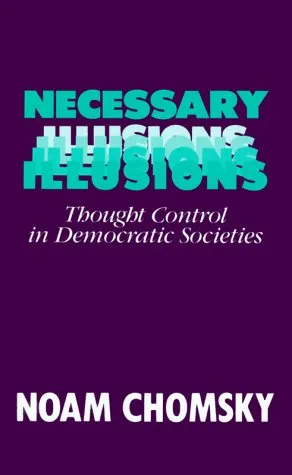
Necessary Illusions- Thought Control In Democratic Societies
Noam Chomsky
English
Intermediate
Technology
4.6 / 5
0 reviews
1999
Published
138
pages
508
views
Necessary Illusions- Thought Control In Democratic Societies media manipulation, democratic discourse An incisive exploration of Necessary Illusions- Thought Control In Democratic Societies and its critique of modern democratic frameworks. Analytical Summary In Necessary Il
Before you read
What will you get from this book?
Analytical Summary
In Necessary Illusions- Thought Control In Democratic Societies, Noam Chomsky presents a penetrating analysis of how information is manufactured, filtered, and distributed in ostensibly free societies. The book dissects the mechanisms through which media institutions and state apparatuses collaborate—often unconsciously—to frame reality in ways that preserve established power structures, curtail public dissent, and narrow the scope of democratic discourse.
Drawing on historical case studies, media reports, and the political economy of communication, Chomsky identifies systematic patterns in news coverage, editorial decision-making, and the construction of public opinion. The text explores how the media, while claiming neutrality and adherence to facts, frequently perpetuate narratives that align with elite interests.
Chomsky’s argument hinges on the observation that in liberal democracies, the consent of the governed is managed through subtle control over ideas rather than overt coercion. This “thought control” relies on the creation and reinforcement of “necessary illusions”—concepts and beliefs that, though presented as truth, mask underlying political agendas. The work is both an analytical treatise and a rallying call for active, critical engagement with the information environments we inhabit.
Key Takeaways
The lessons embedded in Necessary Illusions- Thought Control In Democratic Societies remain highly relevant for readers in academia, media, and politics.
Democratic societies are not immune to propaganda; rather, their media systems often achieve more sophisticated forms of influence than overtly authoritarian regimes.
Critical literacy—understanding who benefits from prevailing narratives—is essential for resisting manipulation within modern communication channels.
Media manipulation and controlled discourse impact public policy priorities, often invisibly, by shaping perceptions of what issues merit attention.
Public engagement and continuous questioning of official sources can counteract the impact of necessary illusions and foster genuine democratic participation.
Memorable Quotes
The smart way to keep people passive and obedient is to strictly limit the spectrum of acceptable opinion.Unknown
In democratic societies, coercion is replaced not by freedom, but by the subtle manufacturing of consent.Unknown
Why This Book Matters
The relevance of Necessary Illusions- Thought Control In Democratic Societies extends beyond its original audience, offering enduring insights into the structures of modern media and governance.
For journalists, policymakers, educators, and engaged citizens, Chomsky’s critique is an invaluable tool for identifying and dismantling the cognitive barriers that prevent meaningful democratic participation.
In an age defined by rapid information exchange and algorithmic news feeds, the ability to discern media manipulation becomes not only a professional skill but a civic duty. The book’s examination of democratic discourse challenges the complacency that can set in when the media landscape appears pluralistic yet functions within narrow ideological bounds.
Inspiring Conclusion
Necessary Illusions- Thought Control In Democratic Societies is more than a scholarly work; it is an invitation to interrogate the beliefs and assumptions we take for granted.
By exposing the subtle mechanisms of thought control in liberal democracies, the book empowers readers to reclaim their intellectual agency. This empowerment is not merely an academic exercise—it is a call to action for informed participation in civic life, responsible media consumption, and the cultivation of public discourse that resists manipulation.
For academics, professionals, and engaged citizens alike, the next step is clear: read the book, share its insights, and discuss its implications with peers, communities, and networks. In doing so, we collectively chip away at the necessary illusions that constrain democratic potential.
Ask this book
Your question is answered in the context of this title and author. Each answer uses 2 points.
Sign in to ask the book assistant.
Reader reviews
0 reviews, 4.6 average out of 5
No reviews yet
If you have read this book, help the next reader with your experience.
Write a review
Sign in to publish a review.
Reader questions and answers
Ask a focused question and learn from the community.
Sign in to ask or answer a question.
No questions yet
Be the first to ask a clear, useful question.
What to read next
Related references that continue this learning path.
Framing Public Life: Perspectives on Media and Our Understanding of the Social World
Stephen D. Reese,Oscar H. Gandy Jr.,August E. Grant
2001
View book
Mass Media, Mass Propaganda: Understanding the News in the 'War on Terror'
Anthony DiMaggio
2008
View book