

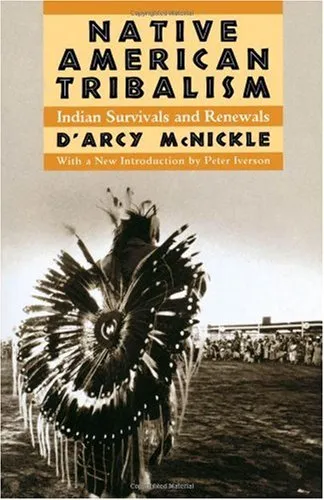
Book guide and evaluation
Native American Tribalism: Indian Survivals and Renewals
D'Arcy McNickle
English
Intermediate
Leadership & Management
4.6 / 5
0 reviews
1993
Published
209
pages
436
views
Contrary to the white man's early expectations, the Indian tribes of North America neither vanished nor assimilated. Despite almost four hundred years of contact with the dominant--and often domineering--Western civilization, Native Americans have maintained their cultural ident
Before you read
What will you get from this book?
Contrary to the white man's early expectations, the Indian tribes of North America neither vanished nor assimilated. Despite almost four hundred years of contact with the dominant--and often domineering--Western civilization, Native Americans have maintained their cultural identity, the size, social organization, and frequently the location of their population, and their unique position before the law. Now brought up to date with a new introduction by Peter Iverson, this classic book reviews the history of contact between whites and Indians, explaining how the aboriginal inhabitants of North America have managed to remain an ethnic and cultural enclave within American and Canadian society from colonial times to the present day. The late D'Arcy McNickle--renowned anthropologist and member of the Flathead Tribe of Montana--shows that while Native Americans have always been eager to adopt the knowledge and technology of white society, they carefully adapt these changes to fit into their own culture. He maintains that by emphasizing tribal self-determination, the federal government can best help Native Americans to modernize and achieve independence even as they preserve their ancient heritage. Iverson's introduction to the new edition discusses McNickle's singular contribution to Native American Studies, and provides an overview of recent events and scholarship in the field. He has also brought up to date the appendix describing the geographical distribution of the principle tribes in the United States and Canada. With its comprehensive coverage and unique perspective, the new edition of Native American Tribalism is essential reading for those who want to understand the past and present of our first Americans.
Ask this book
Your question is answered in the context of this title and author. Each answer uses 2 points.
Sign in to ask the book assistant.
Reader reviews
0 reviews, 4.6 average out of 5
No reviews yet
If you have read this book, help the next reader with your experience.
Write a review
Sign in to publish a review.
Reader questions and answers
Ask a focused question and learn from the community.
Sign in to ask or answer a question.
No questions yet
Be the first to ask a clear, useful question.
What to read next
Related references that continue this learning path.

The Manager’s Path: A Guide for Tech Leaders Navigating Growth and Change
Camille Fournier
2017
View book

Trans Representations in Contemporary, Popular Cinema: The Transgender Tipping Point
Niall Richardson;Frances Smith
2022
View book