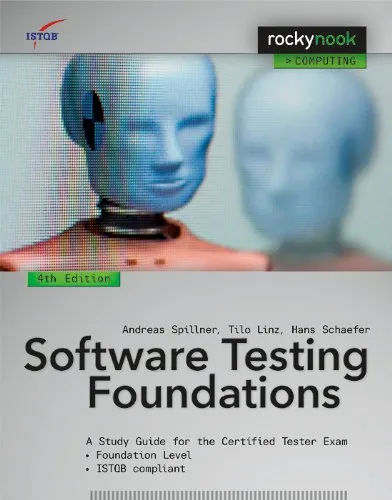
Software Testing Foundations: A Study Guide for the Certified Tester Exam
Andreas Spillner,Tilo Linz,Hans Schaefer
2014
View book

Book guide and evaluation
Jason W. Solomon
0 reviews
Published
pages
views
Introduction to "Music Theory Essentials: A Streamlined Approach to Fundamentals, Tonal Harmony, and Post-Tonal Materials" "Music Theory Essentials: A Streamlined Approach to Fundamentals, Tonal Harmony, and Post-Tonal Materials" is a comprehensive yet accessible g
Before you read
"Music Theory Essentials: A Streamlined Approach to Fundamentals, Tonal Harmony, and Post-Tonal Materials" is a comprehensive yet accessible guide for students, educators, and enthusiasts of music theory. Written with clarity and precision, this book distills fundamental concepts of music theory into a practical and engaging resource that caters to learners from diverse musical backgrounds. By addressing core theoretical concepts while exploring the rich world of tonal harmony and post-tonal materials, the book provides readers with an all-encompassing understanding of both classical and contemporary music theory practices.
This book is structured in a way to guide readers progressively, starting from the very basics and advancing toward more complex ideas in tonal and post-tonal music theory. The journey begins with an exploration of musical fundamentals, such as pitch, rhythm, intervals, and scales, which form the foundation of music theory. These concepts are vital for grasping how music is structured and how its elements interact.
Moving forward, the book introduces tonal harmony, encompassing essential topics such as triads, seventh chords, chord progressions, voice leading, and modulation. These topics are discussed within the context of classical Western music traditions, offering an analytical framework that readers can apply to various compositions. Unlike many traditional music theory texts, this book adopts a streamlined approach—focusing only on the most essential materials while providing real-world examples for better understanding and application.
The final section of the book ventures into the fascinating world of post-tonal materials. This includes an examination of modern-day techniques, such as set theory, serialism, and extended tonality. Readers are introduced to diverse analytical tools used in contemporary music while maintaining focus on accessibility and clarity. This makes the book an invaluable resource for bridging the gap between classical harmony and modern practices.
By combining clear explanations, concise content delivery, and practical examples, "Music Theory Essentials" provides a well-rounded approach suited for both academic environments and self-directed study.
"Music theory is not merely an academic exercise; it is the language through which we understand, create, and communicate the universal power of sound."
"Harmony and melody do not exist in isolation but as partners in a dance, constantly shaping and reshaping our perception of music."
"Post-tonal music invites us to break free from tradition while respecting the vast lineage of musical innovation."
Music theory is often perceived as an intimidating subject, fraught with technical jargon and complex concepts. "Music Theory Essentials" is a breath of fresh air in the realm of music education. It demystifies theoretical concepts and presents them in a logical, straightforward manner that appeals to both beginners and advanced learners. The book's pragmatic approach ensures that readers can immediately apply their knowledge to real-life musical contexts, making it an indispensable tool for composers, performers, and educators alike.
Moreover, this book is particularly important in bridging the gap between traditional western tonal music and the often-overlooked domain of contemporary music theory. By addressing both classical and post-tonal materials, "Music Theory Essentials" equips learners with a holistic understanding of music's evolution and its ongoing dialogue between tradition and innovation.
Whether you are a music student seeking a strong theoretical grounding, a performer interested in deepening your analytical skills, or simply an enthusiast with a curiosity for understanding how music works, this book stands as a definitive guide. It matters because it not only teaches theory but also inspires a deeper love and appreciation for the art of music itself.
Your question is answered in the context of this title and author. Each answer uses 2 points.
0 reviews, 4.5 average out of 5
Sign in to publish a review.
Ask a focused question and learn from the community.
Related references that continue this learning path.
Andreas Spillner,Tilo Linz,Hans Schaefer
Bender, Emily M.;Lascarides, Alex
![Cover of The Feynman Lectures on Physics [Vol 1]](https://s3.refhub.ir/images/thumb/The_Feynman_Lectures_on_Physics__Vol_1_15281.webp)