

English File Fourth Edition Beginner Workbook
Christina Latham-Koenig,Clive Oxenden,Jerry Lambert,with Jane Hudson
2020
View book
Book guide and evaluation
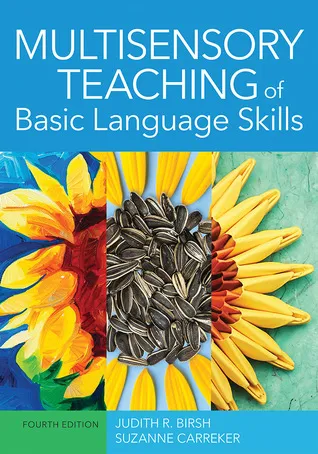
Judith R. Birsh;Suzanne Carreker
0 reviews
Published
pages
views
Introduction "Multisensory Teaching of Basic Language Skills" by Judith R. Birsh and Suzanne Carreker has emerged as an essential guide for educators and professionals dedicated to teaching foundational language skills. Designed with practicality and research in mind, this boo
Before you read
"Multisensory Teaching of Basic Language Skills" by Judith R. Birsh and Suzanne Carreker has emerged as an essential guide for educators and professionals dedicated to teaching foundational language skills. Designed with practicality and research in mind, this book serves as a comprehensive resource for understanding and implementing multisensory strategies to support language development and literacy acquisition—particularly for individuals with learning difficulties, such as dyslexia. By combining evidence-based practices with actionable insights, this text empowers teachers, specialists, and parents to create meaningful learning experiences that cater to diverse learning needs.
The fourth edition of this book builds upon its legacy as a reliable reference. It integrates the latest advancements in neuroscience, literacy education, and instructional best practices. It not only focuses on the “how-to” of teaching language skills but also delves into the science of human learning, offering a deeper understanding of why multimodal instruction is vital for effective learning. Through its detailed lesson plans, assessments, and case studies, the book equips readers to bridge the gap between theory and practice with confidence and expertise.
This resource delves into the principles of multisensory teaching, which engages visual, auditory, kinesthetic, and tactile pathways to enhance learning and memory. Recognizing that students learn in diverse and varied ways, the book emphasizes structured, sequential, and cumulative approaches that are highly effective for building reading, writing, and spelling skills.
Key topics covered in the book include phonemic awareness, decoding, spelling, comprehension, vocabulary, fluency, handwriting, and written expression. Each topic is comprehensively addressed with practical strategies rooted in evidence and research, along with step-by-step guidance for implementation. The authors also explore language structure, including morphology, syntax, and semantics, to provide a holistic understanding of how the English language functions.
The book features contributions from leading experts in the field of language development and literacy, ensuring that readers gain multifaceted perspectives. Moreover, it integrates case studies, sample lesson plans, and instructional checklists, making it an invaluable tool for educators seeking to meet the needs of struggling students.
"Learning to read and write is not a natural act; it is a learned process that requires intentional instruction."
"Multisensory teaching is not just a technique, but a philosophy of teaching the whole learner."
"Teachers are the architects of students’ multilayered understanding of language."
"Multisensory Teaching of Basic Language Skills" is not merely a collection of teaching strategies—it is a profound resource that bridges the gap between research and practice. In a time where literacy continues to be a critical determinant of educational and professional success, this book offers a lifeline for educators and specialists striving to meet the needs of all learners, especially those with specific learning disabilities.
Its holistic and inclusive approach to literacy instruction respects the individuality of each student while offering systematic, evidence-based methods proven to yield results. By providing the tools, knowledge, and frameworks needed to create effective lessons, this book has become an essential reference for anyone looking to foster success in language learning.
More than a textbook, "Multisensory Teaching of Basic Language Skills" stands as a testament to the power of well-designed instruction to transform lives. It emphasizes the critical role educators play in shaping the lifelong literacy journeys of their students, underscoring the importance of dedication, structured teaching, and an unwavering commitment to meeting diverse learning needs.
Your question is answered in the context of this title and author. Each answer uses 2 points.
0 reviews, 4.8 average out of 5
Sign in to publish a review.
Ask a focused question and learn from the community.
Related references that continue this learning path.
Christina Latham-Koenig,Clive Oxenden,Jerry Lambert,with Jane Hudson
Christina Latham-Koenig,Clive Oxenden,Kate Chomacki
Adrian Doff,Craig Thaine,Herbert Puchta,Jeff Stranks,Peter Lewis-Jones

Christina Latham-Koenig,Clive Oxenden,Kate Chomacki