David Hilbert's Lectures on the Foundations of Arithmetic and Logic 1917-1933
William Ewald,Wilfried Sieg (auth.),William Ewald,Wilfried Sieg (eds.)
2013
View book
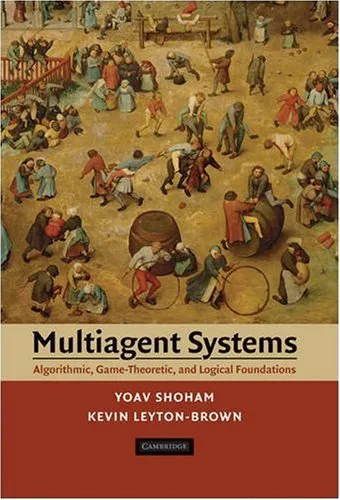
Book guide and evaluation
Yoav Shoham,Kevin Leyton-Brown
0 reviews
Published
pages
views
Introduction to 'Multiagent Systems: Algorithmic, Game-Theoretic, and Logical Foundations' Written by Yoav Shoham and Kevin Leyton-Brown, this seminal book serves as a comprehensive guide to the interdisciplinary field of multiagent systems. It bridges computer science, game t
Before you read
Written by Yoav Shoham and Kevin Leyton-Brown, this seminal book serves as a comprehensive guide to the interdisciplinary field of multiagent systems. It bridges computer science, game theory, and logic, offering a deep exploration of how agents—autonomous entities that perceive and act in an environment—can be designed to reason, interact, and collaborate effectively. Whether you're a researcher, a student, or a professional, this book provides a unified introduction to the underlying concepts that drive multiagent technologies and their applications in real-world scenarios.
At its core, "Multiagent Systems: Algorithmic, Game-Theoretic, and Logical Foundations" is organized around foundational principles in three areas—algorithms, game theory, and logic. Each chapter starts by addressing basic questions, gradually leading the reader to nuanced and advanced concepts. The content is carefully structured to be accessible to readers with diverse backgrounds, blending theoretical depth with practical relevance.
The book begins with an introduction to multiagent systems, establishing the motivations and challenges of designing entities that can think, learn, and collaborate in dynamic environments. Following this, the authors delve deeply into game theory, explaining how agents can model and predict the behavior of others within the framework of strategic interactions. This part introduces key concepts like Nash equilibria, mechanism design, and cooperative game theory.
Next, the book explores algorithms for multiagent systems, ranging from search and planning techniques to machine learning methods for coordination and resource allocation. Crucially, it bridges the gap between theory and practice, showing how these algorithms are applied in domains like robotics, e-commerce, and social computing. Finally, the logical underpinnings of multiagent reasoning are discussed—highlighting formal models of knowledge, belief, and communication. Here, readers learn how logical tools help structure the design and implementation of multiagent systems, particularly in environments that require verification and safety guarantees.
Overall, the book provides a rich foundation in computational techniques, mathematical tools, and conceptual frameworks, presented with clarity and rigor.
Throughout the book, the authors present thought-provoking ideas about the nature of agents and their interactions. Here are some selected excerpts:
“Multiagent systems embody one of the fundamental goals of science: understanding how independent entities can work together.”
“The challenges of multiagent systems can often be understood as a dance between collaboration and competition.”
“To design agents that function in environments as complex as the real world, one must interweave computation, strategy, and logic in equal measures.”
'Multiagent Systems: Algorithmic, Game-Theoretic, and Logical Foundations' is more than just a textbook; it is a cornerstone of multiagent systems research and education. As artificial intelligence increasingly permeates everyday life, understanding how multiple entities—whether machines, humans, or hybrids—interact and collaborate has become a critical challenge. This book provides the conceptual scaffolding needed to address these challenges effectively.
The authors’ interdisciplinary approach reflects the real-world complexity of multiagent systems, combining formal rigor with applied insights. Whether you're developing AI for autonomous vehicles, designing personalized e-commerce recommendations, or analyzing complex social networks, the frameworks and methods in this book are indispensable. Furthermore, its accessible writing style ensures that readers from a variety of fields can grasp the material and apply it in their work.
Ultimately, this book matters because it equips readers with the tools to think critically about autonomy, interaction, and intelligence in modern systems—essential for shaping the future of technology and society.
Your question is answered in the context of this title and author. Each answer uses 2 points.
0 reviews, 4.7 average out of 5
Sign in to publish a review.
Ask a focused question and learn from the community.
Related references that continue this learning path.
William Ewald,Wilfried Sieg (auth.),William Ewald,Wilfried Sieg (eds.)

William Ewald (editor),Wilfried Sieg (editor)
Daniel Andersson,Kristoffer Arnsfelt Hansen (auth.),Arnold Beckmann,Costas Dimitracopoulos,Benedikt Löwe (eds.)