

Williams Obstetrics, 26th Edition
F. Gary Cunningham,Kenneth J. Leveno,Jodi S. Dashe,Barbara L. Hoffman,Catherine Y. Spong,Brian M. Casey
2022
View book
Book guide and evaluation
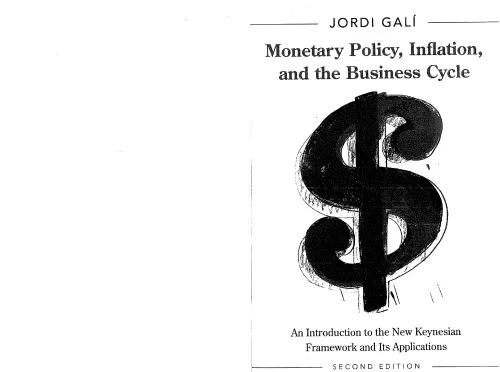
Jordi Gali
0 reviews
Published
pages
views
Introduction to New Keynesian Economics Welcome to a comprehensive exploration of the New Keynesian framework through the lens of the book "Monetary Policy, Inflation, and the Business Cycle: An Introduction to the New Keynesian Framework." This work stands as a fo
Before you read
Welcome to a comprehensive exploration of the New Keynesian framework through the lens of the book "Monetary Policy, Inflation, and the Business Cycle: An Introduction to the New Keynesian Framework." This work stands as a foundational text that synthesizes theoretical insights and empirical findings to provide a cohesive understanding of monetary policy and its intersection with inflation and economic cycles.
"Monetary Policy, Inflation, and the Business Cycle" offers a clear and accessible introduction to the primary features of the New Keynesian model—a framework that integrates price and wage rigidities into macroeconomic analysis. This book sets out to demystify complex economic concepts such as dynamics of inflation and output under various monetary policy rules. The text discusses how these models illuminate the mechanisms of price setting, providing insights into optimal policy design and implementation. Importantly, it addresses both theoretical constructs and practical applications, making it an invaluable resource for those aiming to understand contemporary macroeconomic policy challenges.
Central to the book is the systematic examination of the dynamic stochastic general equilibrium (DSGE) models, with particular attention to their implications for monetary policy. Through a careful calibration and estimation approach, readers are introduced to the quantitative dimensions of the New Keynesian framework, offering a bridge between theoretical abstraction and real-world policy making.
"Economic policy must account for not only the immediate impacts but also the dynamic expectations of future conditions."
"Price stability is not merely an objective; it is a precondition for sustainable economic growth."
In the evolving landscape of global economies, understanding the insights offered by New Keynesian economics is crucial. This book is not just a theoretical text; it serves as a practical handbook for policymakers, economists, and students alike. By bridging the gap between classic Keynesian approaches and modern economic realities, it equips readers with the tools to critically analyze and interpret the effects of monetary policy decisions.
As our world faces new economic challenges, from financial crises to unexpected economic shocks, the principles outlined in this book become even more relevant. They offer a guiding framework to understand how inflation dynamics and business cycles interact with policy interventions, enhancing our ability to foster economic stability and growth.
Your question is answered in the context of this title and author. Each answer uses 2 points.
0 reviews, 4.5 average out of 5
Sign in to publish a review.
Ask a focused question and learn from the community.
Related references that continue this learning path.
F. Gary Cunningham,Kenneth J. Leveno,Jodi S. Dashe,Barbara L. Hoffman,Catherine Y. Spong,Brian M. Casey
Alan Partin,Craig Peters,Louis Kavoussi,Roger Dmochowski,Alan Wein

John E. Bennett &Raphael Dolin &Martin J. Blaser