

Williams Obstetrics, 26th Edition
F. Gary Cunningham,Kenneth J. Leveno,Jodi S. Dashe,Barbara L. Hoffman,Catherine Y. Spong,Brian M. Casey
2022
View book
Book guide and evaluation
Jordi Gali
0 reviews
Published
pages
views
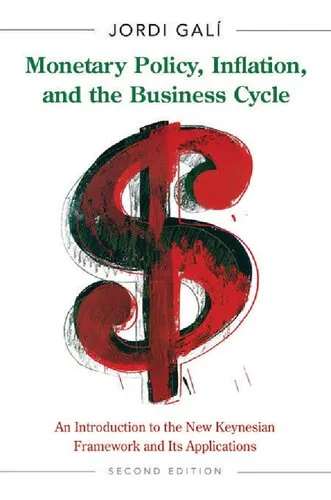
Introduction to "Monetary Policy, Inflation, and the Business Cycle" Welcome to an exploration of the quintessential guide to understanding modern macroeconomic theory: "Monetary Policy, Inflation, and the Business Cycle: An Introduction to the New Keynesian Framework and
Before you read
Welcome to an exploration of the quintessential guide to understanding modern macroeconomic theory: "Monetary Policy, Inflation, and the Business Cycle: An Introduction to the New Keynesian Framework and Its Applications - Second Edition". Authored by Jordi Gali, this book provides a comprehensive overview of the New Keynesian framework, which stands at the forefront of macroeconomic theory. This second edition refines its predecessor by presenting a systematic depiction of the principles shaping today's economic policies and their application to critical economic issues.
The book delves into the complexities of contemporary monetary policy by integrating theoretical advancements with practical implications. It kicks off with the foundational aspects of the New Keynesian framework, which harmonizes traditional Keynesian insights with modern day analytical tools. Readers journey through how prices and wages influence economic actors and the macroeconomy overall, understanding the dynamics of inflation and business cycles.
One of the core strengths of this book is its structured approach to depicting how central banks influence the macroeconomic environment. The text explicates how monetary policy operates under different conditions and elucidates its effects on output, inflation rates, and real economic activity. Readers will appreciate the practical nature of this guide, especially its application of theoretical models via real-world scenarios and policy analysis.
Each chapter presents a focused discourse, encompassing the foundational models and augmenting them with empirical research and policy application. The book culminates by bridging theory with the intricacies of unconventional monetary policy, urging readers to consider its role during economic crises and downturns.
“Modern monetary policy is a complex web of interactions, best understood through the prism of macroeconomic theory yet intricately linked to empirical realities.”
“The New Keynesian framework stands out for its ability to capture the nuances of short-run economic fluctuations, while offering a robust foundation for policy design.”
"Monetary Policy, Inflation, and the Business Cycle" stands as an essential scholarly work for anyone interested in macroeconomic theory and policy. It is not merely a theoretical construct but a vibrant tapestry that marries abstract models with real-world applications. The book's meticulous approach to unraveling complex economic mechanisms makes it valuable to economists, policymakers, academicians, and students alike.
This second edition is particularly significant in its timely revisions and extensions. In the wake of recent global financial turbulences and the ongoing reevaluation of economic strategies, the book provides critical insights into how economic theory adapts to an evolving landscape. Through Gali’s lens, readers are better equipped to understand and critically assess the monetary policies that shape global economic health.
Overall, this book acts as both a compass and a toolkit, directing its readers through the intricate waters of monetary policy and equipping them with the necessary knowledge to navigate future economic challenges adeptly.
Your question is answered in the context of this title and author. Each answer uses 2 points.
0 reviews, 4.6 average out of 5
Sign in to publish a review.
Ask a focused question and learn from the community.
Related references that continue this learning path.
F. Gary Cunningham,Kenneth J. Leveno,Jodi S. Dashe,Barbara L. Hoffman,Catherine Y. Spong,Brian M. Casey

Alan Partin,Craig Peters,Louis Kavoussi,Roger Dmochowski,Alan Wein

John E. Bennett &Raphael Dolin &Martin J. Blaser