Book guide and evaluation
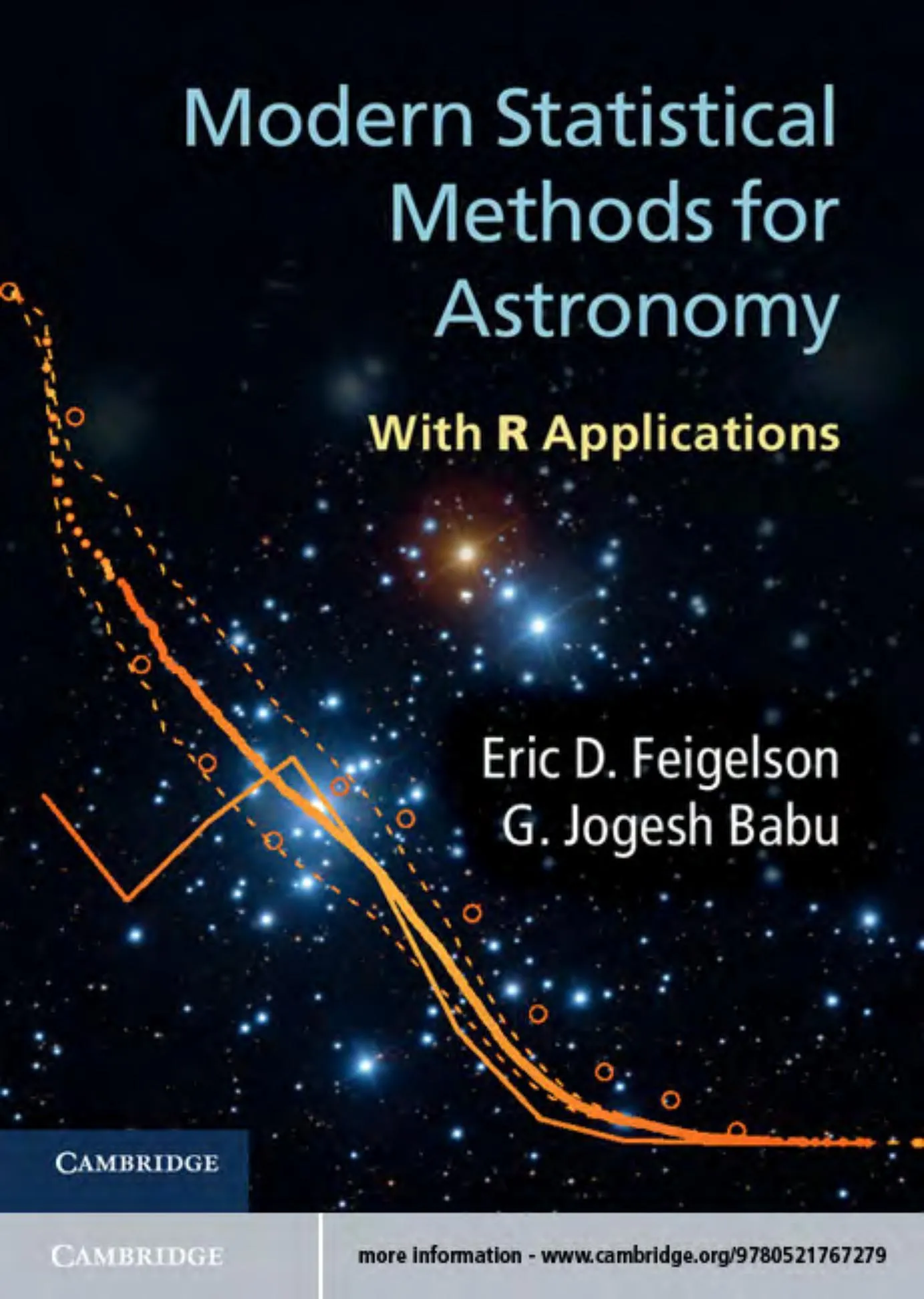
Modern Statistical Methods for Astronomy: With R Applications
Eric D. Feigelson,G. Jogesh Babu
English
Beginner
Astronomy
4.5 / 5
0 reviews
2012
Published
504
pages
499
views
Introduction to "Modern Statistical Methods for Astronomy: With R Applications" "Modern Statistical Methods for Astronomy: With R Applications" bridges the gap between traditional astrophysical data analysis and the rapidly evolving field of modern statistics, meeting the de
Before you read
What will you get from this book?
Introduction to "Modern Statistical Methods for Astronomy: With R Applications"
"Modern Statistical Methods for Astronomy: With R Applications" bridges the gap between traditional astrophysical data analysis and the rapidly evolving field of modern statistics, meeting the demands of the data-driven 21st century. This comprehensive and groundbreaking book provides astronomers, astrophysicists, and data scientists with the tools and methodologies they need to process, analyze, and interpret complex datasets.
Authored by Eric D. Feigelson and G. Jogesh Babu, this resource is specifically designed to introduce statistical principles and their applications to astronomical datasets. By incorporating the R programming language, the text ensures hands-on learning, enabling researchers to directly implement and explore modern statistical concepts. Whether you are a student of astronomy, a professional researcher, or simply someone passionate about statistical data analysis in the context of astronomy, this book offers invaluable guidance through well-structured explanations, examples, and applications.
Detailed Summary of the Book
From foundational statistical concepts to advanced computational techniques, this book delivers a robust educational journey. It begins by introducing the principles of probability distributions, foundations of hypothesis testing, and essentials of data exploration. As students and researchers progress, they are exposed to advanced topics such as Bayesian statistics, machine learning, spatial analysis, and time series forecasting— all indispensable tools in analyzing astronomical datasets.
The integration of the R language in this book sets it apart, offering real-world, hands-on problem-solving experiences. Readers are guided through statistical modeling, data visualization, and simulation techniques—all while applying these in the realm of astronomy. By seamlessly blending theory with code-based examples, "Modern Statistical Methods for Astronomy" makes complex topics accessible and actionable.
Mathematical rigor, complemented by intuitive explanations, guides readers of all levels. Additionally, the book delves into specific astronomic applications such as photometric redshifts, clustering in star formations, exoplanet detections, and galaxy classification. Ultimately, it serves both as a textbook for courses in astronomical data science and as a valuable reference for working professionals.
Key Takeaways
- Master essential statistical techniques tailored for astronomical data.
- Understand advanced methods like Bayesian inference and machine learning for data-rich astronomy.
- Learn how to implement statistical analyses using the R programming language.
- Gain insights into real-world problems in astronomy, such as time series analysis for variable stars or spatial clustering of galaxies.
- Discover the growing intersection of statistics, computation, and astronomy in the modern era.
Famous Quotes from the Book
"Astronomy is no longer a discipline guided by a few key observations, but one driven by big data, requiring the partnership of advanced statistical methodologies."
"We aim to provide a toolkit—both intellectual and computational—that empowers astronomers to extract meaningful insights from the cosmos' vast datasets."
"Statistical innovation is not an accessory to modern astronomy; it is foundational to its transformational breakthroughs."
Why This Book Matters
The rapid evolution of both technology and data capture techniques in recent decades has transformed astronomy into a highly data-intensive science. With telescope arrays, satellites, and other observational instruments producing unprecedented volumes of complex data, traditional techniques for data analysis often fall short. This book emerges as a timely and critical guide, equipping astronomers with the advanced tools they need to work efficiently and effectively in this changing landscape.
Furthermore, the use of R—which has become a leading language in statistics and data science—provides researchers with the practical means to confront and solve real-world challenges. By combining statistical theory, computational tools, and domain-specific applications in astronomy, the book places itself at the forefront of educational resources in astrostatistics. It empowers the next generation of scientists to make sense of big data and uncover transformative insights from the universe.
If you're an astronomer eager to enhance your expertise, a data scientist exploring interdisciplinary applications, or a student seeking a rigorous, hands-on educational resource, "Modern Statistical Methods for Astronomy: With R Applications" is an indispensable treasure trove designed to meet your needs.
Ask this book
Your question is answered in the context of this title and author. Each answer uses 2 points.
Sign in to ask the book assistant.
Reader reviews
0 reviews, 4.5 average out of 5
No reviews yet
If you have read this book, help the next reader with your experience.
Write a review
Sign in to publish a review.
Reader questions and answers
Ask a focused question and learn from the community.
Sign in to ask or answer a question.
No questions yet
Be the first to ask a clear, useful question.
What to read next
Related references that continue this learning path.