
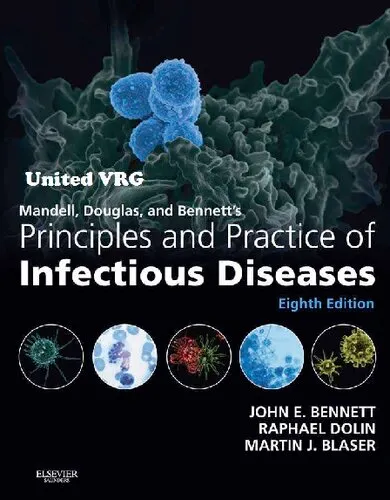
Mandell, Douglas and Bennett's principles and practice of infectious diseases
Gerald L. Mandell;John E. Bennett;Martin J. Blaser;Raphael Dolin (eds.)
2015
View book

Book guide and evaluation
Paulo Pinheiro,Colin D. Mathers,Alexander Krämer (auth.),Alexander Krämer,Mirjam Kretzschmar,Klaus Krickeberg (eds.)
0 reviews
Published
pages
views
Introduction to "Modern Infectious Disease Epidemiology" "Modern Infectious Disease Epidemiology: Concepts, Methods, Mathematical Models, and Public Health" serves as a comprehensive guide to understanding the diverse dimensions of infectious disease epidemiology. This boo
Before you read
"Modern Infectious Disease Epidemiology: Concepts, Methods, Mathematical Models, and Public Health" serves as a comprehensive guide to understanding the diverse dimensions of infectious disease epidemiology. This book stands as a testament to the rapidly evolving field of epidemiology and its importance in addressing some of the world's most pressing public health challenges. Combining theoretical frameworks, epidemiological methods, mathematical modeling techniques, and practical applications, the book is an invaluable resource for students, researchers, and public health professionals.
Written by experts in the field, this book bridges the gap between classical epidemiology and modern analytical methods. The material is presented in a way that balances theoretical discussions with real-world applications, making it accessible to beginners while still offering depth for advanced readers.
The book starts with foundational concepts, introducing the reader to the basic epidemiology of infectious diseases. Core topics such as transmission dynamics, herd immunity, and the distinction between endemic and epidemic diseases are explained clearly. The authors then delve into statistical and mathematical models that have become essential in predicting and understanding the spread of diseases. Methods such as SIR (Susceptible-Infectious-Recovered) models, cohort analyses, and outbreak investigations are covered extensively.
The next section focuses on integrating these concepts into public health practice. Case studies and examples from diseases like HIV, tuberculosis, influenza, and more contemporary challenges such as emerging viral outbreaks are presented, demonstrating the relevance of epidemiology in guiding public health interventions. Additionally, the book explores global health dimensions, addressing disparities in disease burden and the challenges of disease control in both high- and low-resource settings.
One of the unique features of this book is its emphasis on interdisciplinary approaches. Readers are encouraged to look beyond biology and medicine, incorporating insights from sociology, economics, and computer science into their epidemiological studies. With advancements in big data and computational power, the text also touches on how modern tools have reshaped the field, equipping readers with skills to tackle contemporary problems.
"Infectious diseases do not recognize borders—neither geographic, political, nor social."
"The effective control of infectious diseases requires more than just knowledge; it necessitates coordinated action backed by precise data and robust models."
Infectious diseases remain one of humanity's greatest challenges, as evidenced by epidemics and pandemics that have shaped the world. From the crises of HIV to the global disruptions caused by COVID-19, understanding infectious disease epidemiology has never been more crucial.
This book not only equips readers with the epidemiological tools and skills needed to study infectious diseases but also empowers them to think critically and globally. Its interdisciplinary approach ensures that the solutions proposed are grounded in both data-driven practices and a deep appreciation of social contexts. Whether you're an aspiring epidemiologist, a public health official, or a policymaker looking to make data-informed decisions, this book offers the knowledge base and analytical skills you need.
In a world where infectious diseases continue to emerge and re-emerge, "Modern Infectious Disease Epidemiology" is your essential companion in understanding, predicting, and mitigating these threats to human health.
Your question is answered in the context of this title and author. Each answer uses 2 points.
0 reviews, 4.5 average out of 5
Sign in to publish a review.
Ask a focused question and learn from the community.
Related references that continue this learning path.
Gerald L. Mandell;John E. Bennett;Martin J. Blaser;Raphael Dolin (eds.)

David N Gilbert,Georges M Eliopoulos,Henry F Chambers,Michael S Saag,Andrew T Pavia
David W. Kimberlin;Sarah S. Long;Michael T. Brady;Mary Anne Jackson
American Academy of Pediatrics,David W. Kimberlin,Elizabeth D. Barnett,Ruth Lynfield,Mark H. Sawyer