Book guide and evaluation
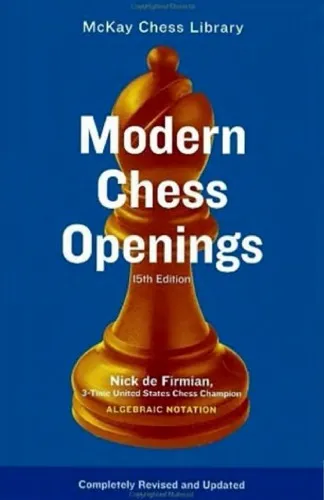
Modern Chess Openings
Nick De Firmian
English
Unordered
Game Theory
4.3 / 5
0 reviews
2008
Published
766
pages
448
views
Modern Chess Openings chess opening theory, strategic chess preparation Modern Chess Openings provides authoritative guidance for players seeking to master opening theory and enhance strategic play. Analytical Summary First published in the early 20th century and
Before you read
What will you get from this book?
Analytical Summary
First published in the early 20th century and developed over successive editions, Modern Chess Openings has become the established reference guide for serious chess competitors, coaches, and theoreticians. The book distills a vast landscape of opening systems into a coherent framework, enabling players to prepare intelligently against a wide variety of opponents.
The work covers both classical and contemporary opening strategies, examining core principles such as central control, piece development, and pawn structure integrity. Through clear organization and structured classification, it grants readers an encyclopedic yet practical tool to navigate evolving chess opening theory.
Over multiple editions, the text has remained relevant by integrating fresh analysis from grandmaster practice and modern engine evaluation. Each chapter dissects thematic ideas behind the moves, providing not just move orders, but the strategic and tactical justifications that underpin them. Information on specific publication years or editorial adjustments between editions may be incomplete; certain edition-level details are “Information unavailable” due to no reliable public source.
Key Takeaways
By engaging with Modern Chess Openings, readers acquire a disciplined framework for understanding how the first moves of a chess game shape the middlegame and endgame.
The book emphasizes the importance of purposeful preparation. Rather than memorizing endless move sequences, it trains users to recognize recurring patterns and strategic goals.
It bridges classical theory with modern developments, illustrating how traditional principles hold their ground while adapting to contemporary innovations.
Secondary benefits include the expansion of analytical thinking skills, improved memory for patterns, and refined ability to evaluate positions objectively.
Memorable Quotes
"The opening is the setting of the stage; the rest of the game is the unfolding drama." Unknown
"To master the opening is to begin the game with confidence and clarity." Unknown
"Theory is useful; understanding is indispensable." Unknown
Why This Book Matters
Modern Chess Openings holds a unique position as both a historical record and a living document of chess evolution.
For educators, it offers a structured way to introduce complex concepts to students of varying strengths. For professionals, it serves as a benchmark when analyzing the latest competitive trends. Academic researchers can mine its pages for insights into how openings have shifted across decades, reflecting broader changes in strategic emphasis brought by technological advancements and global competitive play.
Chess opening theory is not static; it is an evolving dialogue between generations of players. This book acts as a gateway into that dialogue, demanding active engagement and study, yet rewarding the diligent reader with a profound command over one of the most critical phases of the game.
Inspiring Conclusion
In mastering Modern Chess Openings, you are not merely memorizing sequences—you are embracing a centuries-old quest to perfect the art of the first moves.
The book invites you to analyze, adapt, and innovate, no matter your playing style or competitive level. Through its pages, you gain both the technical precision and the creative flexibility to navigate any position from the outset with assurance.
Serious players, scholars, and passionate enthusiasts are encouraged to delve into the text, share their insights with peers, and discuss its wealth of ideas. Now is the time to read, reflect, and elevate your game with the enduring guidance of Modern Chess Openings.
Ask this book
Your question is answered in the context of this title and author. Each answer uses 2 points.
Sign in to ask the book assistant.
Reader reviews
0 reviews, 4.3 average out of 5
No reviews yet
If you have read this book, help the next reader with your experience.
Write a review
Sign in to publish a review.
Reader questions and answers
Ask a focused question and learn from the community.
Sign in to ask or answer a question.
No questions yet
Be the first to ask a clear, useful question.
What to read next
Related references that continue this learning path.