

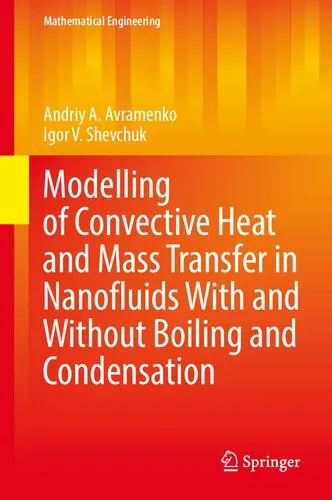
Book guide and evaluation
Modelling of Convective Heat and Mass Transfer in Rotating Flows
Igor V. Shevchuk (auth.)
English
Beginner
Physics
4.9 / 5
0 reviews
2016
Published
253
pages
183
views
Introduction to "Modelling of Convective Heat and Mass Transfer in Rotating Flows" The book "Modelling of Convective Heat and Mass Transfer in Rotating Flows" is a comprehensive exploration of the intricate physical phenomena involved in convective heat and mass tr
Before you read
What will you get from this book?
Introduction to "Modelling of Convective Heat and Mass Transfer in Rotating Flows"
The book "Modelling of Convective Heat and Mass Transfer in Rotating Flows" is a comprehensive exploration of the intricate physical phenomena involved in convective heat and mass transfer within rotating systems. Authored by Igor V. Shevchuk, this work is an essential resource for researchers, engineers, and academics looking to deepen their understanding of the complex dynamics governing heat and mass transfer in rotating environments. The book adopts a rigorous approach to modeling, presenting mathematical frameworks, analytical solutions, and practical applications essential for various engineering disciplines.
Over recent decades, the role of rotating systems has grown significantly in modern technology, with applications ranging from rotating machinery in power plants to aerospace systems and energy harvesting technologies. This book serves as a bridge between the theoretical modeling of convective transfer and its industrial applications, making it both scientifically robust and practically relevant. Written with clarity and precision, the book is suitable for advanced learners and professionals eager to tackle challenging problems in this domain.
Detailed Summary of the Book
"Modelling of Convective Heat and Mass Transfer in Rotating Flows" provides a systematic treatment of the theoretical and practical aspects of convection in rotating systems. The text delves into the fundamentals of fluid dynamics and thermodynamics, discussing how rotation affects heat and mass transfer processes in various configurations. Through the application of mathematical modeling, the book develops generalized equations that describe rotational flows, addressing both laminar and turbulent regimes.
The work comprises detailed discussions on topics such as boundary-layer flows, Coriolis and centrifugal forces in heat and mass transfer, and the impact of geometries like rotating disks and cylinders. Analytical techniques are enriched by numerical simulations, showcasing how computational tools complement and expand theoretical understanding. Furthermore, the book illustrates how these principles are critical in designing efficient thermal systems for industries like gas turbines, mechanical equipment, and environmental engineering.
By combining fundamental concepts with practical examples and advanced modeling techniques, the book enables learners to develop predictive solutions to engineering challenges involving rotating and convective flows.
Key Takeaways
- Comprehension of the underlying physics governing convective heat and mass transfer in rotating systems.
- Practical knowledge of mathematical modeling approaches and their industrial applications.
- An introduction to numerical simulations to solve real-world engineering problems.
- An appreciation of the role of boundary conditions, flow regimes, and system geometry in rotating flows.
- Insight into modern technologies that rely on convective processes influenced by rotation.
Famous Quotes from the Book
"The behavior of convective heat and mass transfer in rotating systems is not merely a fundamental scientific question but the backbone of technological advancements in several high-performance engineering applications."
"Through mathematical rigor and physical intuition, we connect the abstract phenomena of rotation-induced convection with the practical realities faced by engineers and scientists."
"To understand the dynamics of rotating flows is to unlock the potential of countless technologies that shape the modern world."
Why This Book Matters
The significance of "Modelling of Convective Heat and Mass Transfer in Rotating Flows" lies in its ability to bridge the gap between theory and application. As industries increasingly rely on rotating equipment and systems, understanding heat and mass transfer in these contexts has become critical. This book not only deepens technical knowledge but also fosters innovative thinking that can lead to the development of more efficient and sustainable systems.
The methodologies presented in the book are universally relevant, transcending specific disciplines to empower professionals in aerodynamics, thermodynamics, chemical engineering, and beyond. By equipping readers with advanced tools and insights, the book paves the way for solving some of the most pressing engineering challenges of today's world.
Whether you are conducting cutting-edge research or designing machinery that relies on rotational dynamics, this book serves as a guide and inspiration for unlocking the full potential of convective heat and mass transfer in rotating flows.
Ask this book
Your question is answered in the context of this title and author. Each answer uses 2 points.
Sign in to ask the book assistant.
Reader reviews
0 reviews, 4.9 average out of 5
No reviews yet
If you have read this book, help the next reader with your experience.
Write a review
Sign in to publish a review.
Reader questions and answers
Ask a focused question and learn from the community.
Sign in to ask or answer a question.
No questions yet
Be the first to ask a clear, useful question.
What to read next
Related references that continue this learning path.



Modern Computer Vision with PyTorch: A Practical Roadmap From Deep Learning Fundamentals to Advanced Applications and Generative AI, 2nd Edition
V Kishore Ayyadevara,Yeshwanth Reddy
2023
View book