

Book guide and evaluation
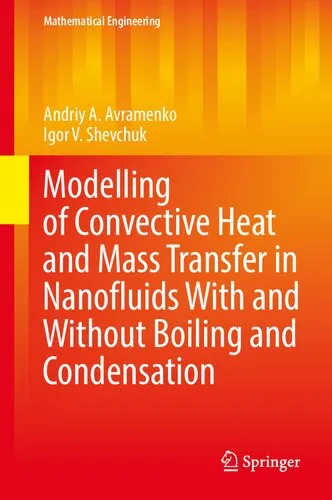
Modelling of Convective Heat and Mass Transfer in Nanofluids with and without Boiling and Condensation (Mathematical Engineering)
Andriy A. Avramenko,Igor V. Shevchuk
English
Beginner
Engineering
4.7 / 5
0 reviews
2022
Published
275
pages
228
views
Introduction to "Modelling of Convective Heat and Mass Transfer in Nanofluids with and without Boiling and Condensation" "Modelling of Convective Heat and Mass Transfer in Nanofluids with and without Boiling and Condensation" is a comprehensive resource dedicated to unrave
Before you read
What will you get from this book?
Introduction to "Modelling of Convective Heat and Mass Transfer in Nanofluids with and without Boiling and Condensation"
"Modelling of Convective Heat and Mass Transfer in Nanofluids with and without Boiling and Condensation" is a comprehensive resource dedicated to unraveling the complexities of heat and mass transfer phenomena in nanofluids. Written by Andriy A. Avramenko and Igor V. Shevchuk, this book delves into the mathematical and engineering principles governing nanofluids—an advanced class of fluid designed for enhanced thermal performance. Through rigorous research and easy-to-follow mathematical formulations, it explores critical topics such as the behavior of convective flows, phase-change processes, boiling, and condensation in the context of nanofluids. Blending theoretical depth with practical insights, the book serves as an invaluable reference for researchers, engineers, and students keen on mastering the next frontier in heat transfer and thermal management technologies.
Detailed Summary of the Book
This book meticulously explores the multi-faceted world of heat and mass transfer, focusing on nanofluids, which are engineered by dispersing nano-sized particles into conventional base fluids. The authors provide a snapshot of the immense potential of these fluids, noting their exceptional thermophysical properties like enhanced thermal conductivity, viscosity, and specific heat capacity. From core mathematical models to cutting-edge experimental approaches, the text reveals the mechanisms underlying energy transfer in nanofluids used in a wide array of applications, such as industrial cooling, energy systems, and microelectronics.
The content spans detailed analyses of convective motions in laminar and turbulent regimes, shedding light on innovative models that describe single-phase and two-phase heat transfer. The physics of boiling and condensation phenomena specific to nanofluids is explained in-depth, offering key insights into their practical implementation. Furthermore, readers are introduced to numerical modeling techniques that simulate these complex processes using advanced computational methods. By combining scientific rigor with an emphasis on real-world applications, this book is designed to fill the knowledge gap faced by academics and practitioners alike in modern heat and mass transfer research.
Key Takeaways
- Comprehensive understanding of the thermophysical behavior of nanofluids and their application in heat and mass transfer.
- Detailed discussion on boiling and condensation dynamics in nanofluids, including their unique thermal behaviors compared to traditional fluids.
- Insights into mathematical modeling and computational techniques used in simulating convective and phase-change processes.
- A blend of theory and practical engineering applications aimed at fostering innovation in nano-based thermal management systems.
- Robust coverage of turbulence modeling and its implications for large-scale industrial heat transfer operations.
Famous Quotes from the Book
"Nanofluids are not just a novelty in fluid thermodynamics—they represent the culmination of decades of research aiming to redefine efficiency in heat and mass transfer applications."
"Understanding the microphysics of boiling and condensation in nanofluids is akin to unlocking the next chapter in sustainable energy systems."
Why This Book Matters
In a rapidly evolving world, where energy efficiency and advanced cooling technologies dictate the pace of industrial growth, this book stands out as a beacon of knowledge in nanofluid research. Its specialized focus on convective heat transfer, boiling, and condensation offers critical insights for developing next-generation cooling systems, from high-performance electronics to greener power plants. Academic researchers and students will appreciate its mathematical rigor and structured approach, helping bridge the gap between theoretical models and real-world applications.
For the engineering community, this book delivers practical methodologies for harnessing the unique properties of nanofluids. Whether you are innovating in renewable energy systems or reducing thermal bottlenecks in cutting-edge device designs, the principles outlined within this text are actionable and applicable. Furthermore, its attention to sustainable energy systems ensures that the advancements described are not only technical marvels but also environmentally conscientious solutions for a better future.
Ask this book
Your question is answered in the context of this title and author. Each answer uses 2 points.
Sign in to ask the book assistant.
Reader reviews
0 reviews, 4.7 average out of 5
No reviews yet
If you have read this book, help the next reader with your experience.
Write a review
Sign in to publish a review.
Reader questions and answers
Ask a focused question and learn from the community.
Sign in to ask or answer a question.
No questions yet
Be the first to ask a clear, useful question.
What to read next
Related references that continue this learning path.



Modern Computer Vision with PyTorch: A Practical Roadmap From Deep Learning Fundamentals to Advanced Applications and Generative AI, 2nd Edition
V Kishore Ayyadevara,Yeshwanth Reddy
2023
View book